Bloating after meals: common causes and when to get it checked
You know the feeling. Dinner was good, maybe a little too good, and forty minutes later your waistband is pressing, your stomach feels tight as a drum and the sofa looks far more inviting than the washing up. By morning it has usually gone.
That ordinary, after-dinner kind of bloating is one of the most common gut complaints there is, and most of the time it says more about how and what we ate than about any illness. But bloating is also a symptom doctors take seriously in certain situations, so it helps to know the difference. Below are the usual causes, a few habits from the Japanese table that are worth borrowing, and the signs that mean it is time to stop experimenting at home and get checked.
Feeling bloated and looking bloated
Doctors often separate two things that the rest of us lump together. Bloating is the sensation: pressure, fullness, the sense that something is trapped. Distension is the visible part, when the belly actually measures bigger. You can have either one on its own.
The pattern over a day is a useful clue. Bloating from gas and a sensitive gut tends to build after meals, peak in the evening and settle overnight, so the stomach is flatter again when you wake up. Swelling that is still there in the morning, that keeps growing over weeks, or that arrives with other symptoms is a different matter. I come back to it near the end.
Where all that gas comes from
There are two main sources. The first is air you swallow. Everyone swallows a little with each mouthful, and some habits add a lot more: eating quickly, talking while chewing, chewing gum, drinking through a straw, smoking, and fizzy drinks, whether that means sparkling water, beer or the highballs that turn up at so many Japanese dinners. Swallowed air mostly comes back up as burping. Some of it travels on.
The second source is your own gut bacteria. Some carbohydrates are not fully absorbed in the small intestine, and when they reach the large intestine, bacteria ferment them and release gas. Nutrition researchers group many of these under the name FODMAPs (short for fermentable oligosaccharides, disaccharides, monosaccharides and polyols). The list is long and a little surprising: onions and garlic, wheat, beans, apples, pears, honey, and the sugar alcohols such as sorbitol and xylitol that sweeten sugar-free mints and gum. In a Japanese kitchen you can add negi (long green onion), gobo (burdock root), soybeans in their many forms, and satsumaimo (sweet potato), which children in Japan have joked about for generations for exactly this reason.
None of these foods is bad. Fermentation is a normal job of a healthy gut, and many of the same foods feed the bacteria we want to keep. The question is only how much gas your gut makes, and how much it notices.
That second part matters more than people expect. Some of us produce ordinary amounts of gas but feel it far more, because the nerves in the gut wall are extra sensitive. This is common in irritable bowel syndrome (IBS), and it explains why two people can share the same pot of bean stew and have completely different evenings.
The usual suspects at a glance
| What may be going on | How it often feels | What often helps |
|---|---|---|
| Swallowed air | Burping and upper fullness soon after eating | Slower meals, fewer fizzy drinks, no gum |
| Fermentable foods (FODMAPs) | Gas and lower-belly swelling that build over the next few hours | A food diary, then smaller portions of your own main suspects |
| Lactose | Gas, cramps or loose stools after milk or soft dairy | Smaller servings, yogurt or hard cheese, lactose-free milk |
| A large or rich meal | A heavy, stretched feeling that lasts for hours | Smaller portions, lighter food late in the evening |
| Constipation | Bloating that builds over days and eases after a bowel movement | Fiber added slowly, enough fluid, daily movement |
| IBS or functional dyspepsia | Recurring bloating, often tied to stress or certain foods | A proper diagnosis first, then a plan with a doctor or dietitian |
A few of these deserve a word more.
Lactose is a big one for anyone with East Asian roots. Most adults in East Asia make much less of the enzyme that digests milk sugar than they did as children, which is the usual human pattern rather than a disorder. Plenty of people still manage a splash of milk in tea, and yogurt and hard cheeses tend to be easier because they contain less lactose. A large cold glass of milk, or a big milky latte on an empty stomach, is another story.
Big, rich meals slow the stomach down. Fat in particular delays how fast the stomach empties, so a generous plate of tonkatsu (breaded pork cutlet) or a bowl of ramen in thick pork-bone broth can leave you feeling stretched for hours. That is normal physiology, not a sign that something is wrong with you.
Constipation is easy to overlook because people think of it as a separate problem. When stool moves slowly, gas has more time to build and less room to move, so bloating and constipation often travel together.
Other causes are less common but real: functional dyspepsia (fullness after only small amounts of food, mostly in the upper belly), reflux, celiac disease, an overgrowth of bacteria in the small intestine, slow stomach emptying in people with long-standing diabetes, and side effects from some medicines, including certain painkillers, iron tablets and some diabetes drugs. Many women also notice more bloating in the days before a period. If you suspect a medicine, ask your doctor or pharmacist before you stop taking anything.
Borrowing from the Japanese table
Japanese home cooking has a few habits that happen to suit a touchy stomach.
The first is the old Okinawan saying hara hachi bu, eating until you are about 80 percent full. It is easier said than done, but the idea of stopping before you feel the stretch is exactly right for after-meal bloating.
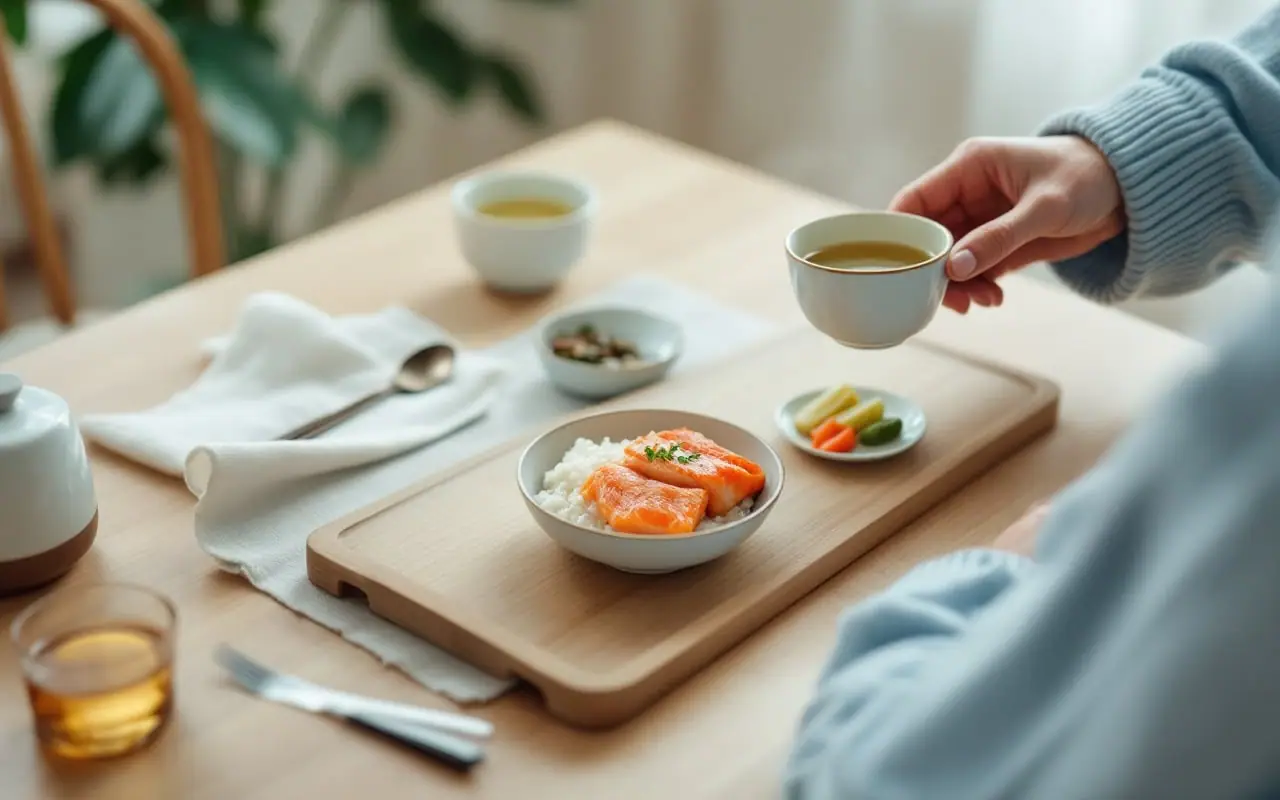
The second is the shape of the meal. A traditional home meal, ichiju sansai (one soup and three side dishes), spreads the food across several small bowls instead of one big plate. Small dishes slow you down without any effort, because you keep moving between them, and a little of many things is gentler than a mountain of one.
The third is speed. Eating fast is treated as a real health habit in Japan. The standard questionnaire used at health check-ups for adults aged 40 to 74 asks whether you eat faster than other people, and public health campaigns have encouraged chewing each mouthful about thirty times. I will not pretend I count. But I do use a hashioki (chopstick rest), and putting the chopsticks down between bites is the simplest brake I know.
A two-week experiment at home
If your bloating is the ordinary after-meal kind and none of the warning signs below apply to you, it is reasonable to spend a couple of weeks working out your own pattern.
Start with a simple diary. Note what you ate and roughly when, when the bloating started, how bad it was on a scale of one to ten, and your bowel habits. Two weeks is usually enough for a pattern to show, and the culprit is often not the food you suspected.
Then change one thing at a time. Cut fizzy drinks for a week. Or keep milk to a splash in tea. Or halve the onions and garlic. Change everything at once and you learn nothing, except how dull a narrow diet can be.
Add fiber slowly. Fiber helps constipation, but a sudden jump from white bread to bowls of beans and bran will produce more gas before the gut adapts. Build up over a few weeks and drink enough water.
Take a short walk after dinner. Gentle movement seems to help gas move along, and small studies suggest light activity can ease bloating in some people. Ten or fifteen minutes around the neighborhood is plenty.
About the low-FODMAP diet: in trials it helps many people with IBS, but it is designed as a short elimination phase followed by careful reintroduction, ideally with a dietitian. Followed strictly for months, it can narrow what you eat and may reduce some of the gut bacteria you want to keep. It is a tool for a diagnosed problem, not a way of life.
Peppermint oil capsules have reasonable evidence for IBS symptoms, but they can make heartburn worse, so a pharmacist is the right person to ask about them. Probiotics are a mixed picture. Some people with IBS report less bloating, reviews have found inconsistent results, and different strains behave differently. If you try one, give it about a month and stop if nothing changes.
When to get it checked
Ordinary bloating is uncomfortable, not dangerous. These situations are different.
Get urgent care, the same day, if bloating comes with severe or worsening belly pain, a hard swollen belly with vomiting and no passing of gas or stool, a fever, vomiting blood or something that looks like coffee grounds, black tarry stools or blood in your stool, or feeling faint. In Japan that means calling 119; elsewhere, your local emergency number.
Book an appointment with a doctor soon, not someday, if:
- you have felt bloated most days for three weeks or more
- you are losing weight without trying
- swallowing has become difficult, or food seems to stick on the way down
- you keep vomiting
- you fill up after only a few mouthfuls, or your appetite has dropped away
- your bowel habits have changed and stayed changed for several weeks
- you are over 50 and this is new for you
- you have a family history of bowel, stomach or ovarian cancer
- you feel unusually tired or short of breath, which can be a sign of anemia
For women, persistent bloating is one of the recognized early symptoms of ovarian cancer, especially after 50. Health services such as the NHS list it alongside feeling full quickly, pain in the lower belly and needing to urinate more often. It is far more likely to be something ordinary, but it is exactly the kind of symptom to mention rather than wait out. Swelling that comes with puffy ankles or breathlessness also needs prompt attention.
A doctor will usually start with questions and an examination, then possibly blood tests (including one for celiac disease, which should be done before you cut out gluten), stool tests, breath tests for lactose intolerance or bacterial overgrowth, or a camera test. In Japan a gastroscopy is quick to arrange and familiar to many adults from stomach cancer screening, so do not let worry about the test keep you away. If you like to read ahead, the US National Institute of Diabetes and Digestive and Kidney Diseases has clear, plain-language pages on gas, IBS and these tests.
There is more on digestion in our gut health section, and everyday cooking ideas under food and seasons.
Tonight's small change
If you take one thing from this, make it speed. At your next meal, put your chopsticks or fork down between every bite, leave the fizzy drink for another day, and stop when you could still eat a little more. Then notice how you feel an hour later. Your own gut is a patient teacher, as long as you also know when to hand the question over to a doctor.

The writer
Naoko is a food and nutrition writer from Fukuoka who studied nutrition before she took up writing. She covers gut health and everyday eating, and most of her ideas start at the kitchen counter.