Acid reflux at night: habits that help and warning signs

It usually starts an hour or two after bed. A burning feeling rises behind the breastbone, or a sour taste reaches the back of the throat, and you wake up coughing. In Japanese this is muneyake, literally "chest burning", and plenty of people who never notice it during the day know it well at 2 a.m.
Heartburn after a big meal now and then is common and usually harmless. When it happens often, or when stomach contents keep coming back up into the gullet (the esophagus), doctors call it gastroesophageal reflux disease, or GERD. A common working definition is reflux symptoms twice a week or more, or reflux that has started to inflame or damage the esophagus. The inflamed version is called gyakuryusei shokudoen (reflux esophagitis) in Japan, a phrase you may see on an endoscopy report.
Why lying down changes things
At the bottom of the esophagus sits a ring of muscle, the lower esophageal sphincter, which works as a one-way valve. It opens to let food into the stomach and should stay closed the rest of the time. In people with reflux it relaxes at the wrong moments, and acid slips back up.
During the day, three things work in your favor. Gravity keeps the stomach's contents at the bottom. You swallow often, which pushes anything that refluxes back down. And saliva, which is mildly alkaline, washes over the lining and neutralizes some of the acid.
At night all three weaken. Lying flat removes the help of gravity, and during sleep you swallow far less and make less saliva, so acid that comes up at 2 a.m. stays in contact with the lining longer than it would at noon. Doctors take night symptoms seriously for that reason: they are linked with more irritation of the esophagus, and they break up sleep.
A full stomach adds to the problem. When the stomach is stretched, the valve relaxes more often in short bursts, and these brief relaxations are the main way reflux happens. So the size of the evening meal and how soon you lie down after it often matter more than any single "bad" food.
Night reflux does not always feel like heartburn. Some people notice a dry cough when they lie down, a hoarse voice in the morning, a sore throat, or waking with a choking feeling. These can have other causes too, so mention them to a doctor rather than assuming.
Late dinners, Japanese style
A Japanese home meal of rice, miso soup, grilled fish and pickles is fairly light. The trouble is more often when it is eaten.
Long working hours and long commutes push dinner late for many office workers in Japanese cities. Getting home at 9 or 10 p.m. and eating a full meal shortly before bed is ordinary. Japanese gastroenterologists have also noted that reflux disease has become more common here over recent decades. The explanations usually offered are falling rates of Helicobacter pylori infection (which in many people reduced stomach acid), a richer diet and rising body weight. Late eating fits easily into that picture.
Then there is the after-work drink. An evening at an izakaya (a casual pub serving many small plates) often runs for two or three hours: beer, highballs or sake alongside fried chicken, grilled skewers, and maybe fried rice to finish. Because the food keeps coming, the stomach never gets a chance to empty. Your "last meal" is effectively whenever you leave.
In Fukuoka, where I live, the classic end to a night out is shime no ramen, the bowl of noodles that closes the evening. A rich tonkotsu (pork bone) broth is very good at midnight, but it is fatty, and fat slows the emptying of the stomach. Add alcohol, which relaxes the valve at the bottom of the esophagus, and fizzy drinks, which add gas and pressure, then go straight to bed. Many people with reflux will recognize that sequence.
In winter there is the kotatsu (a low heated table covered with a quilt) and the habit of gorone, lying down for a casual doze right after dinner. It is comfortable and, for reflux, badly timed.
None of this means giving up ramen or nights out. It means knowing which part of the evening does the damage, which is mostly timing and volume.
An evening routine that helps
The steps below match what sources such as the NHS and American gastroenterology guidelines suggest for night reflux. Which ones help most varies from person to person.
- Leave a gap before bed. Guidance commonly suggests finishing the last meal at least 2 to 3 hours before lying down, and the NHS suggests 3 to 4 hours. If you get home late, consider splitting dinner. Japanese diet advice for late workers sometimes calls this bunshoku (dividing a meal): a rice ball or some fruit at the office around 6 p.m., then a small bowl of soup or some tofu at home instead of a full plate.
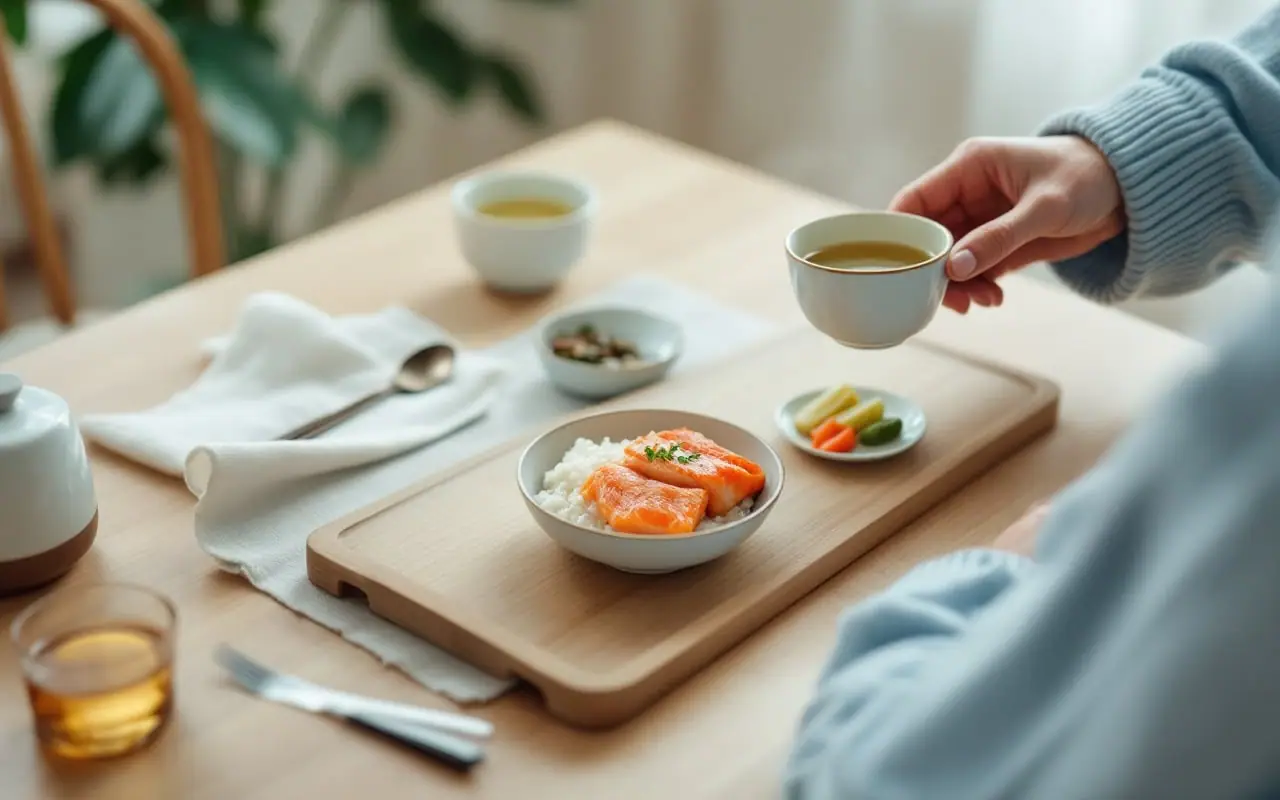
- Make the last meal smaller and less fatty. Grilled fish rather than karaage, a light dashi soup rather than a rich broth, a half portion where the shop offers one. The old saying hara hachi bu, eat until you are about 80 percent full, suits reflux well.
- Go easy on alcohol, especially late. Fewer drinks and an earlier last one make a difference for many people.
- Stay upright after eating. A short walk, washing up, or sitting at the table is better than lying under the kotatsu.
- Loosen the waistband. Tight belts and snug clothes press on a full stomach.
- Raise the head of the bed, not just your head. More on this below.
- Try sleeping on your left side. Also below.
- If you smoke, count reflux as one more reason to stop. Smoking weakens the valve and reduces saliva.
- If you carry extra weight around the middle, losing some is one of the better-supported ways to reduce reflux, since abdominal fat presses on the stomach.
Food triggers are personal. Coffee, chocolate, peppermint, citrus, tomatoes, spicy dishes and fizzy drinks bother some people and not others. Keeping a simple note for two weeks (what you ate, when you went to bed, how the night went) tells you more than cutting out a long list of foods on spec.
Bed blocks rather than pillows
The change with the most consistent support for night symptoms is raising the head end of the bed so that your whole upper body slopes gently down toward your feet. The NHS suggests raising it by about 10 to 20 centimeters, for example with sturdy blocks under the bed legs at the head end, or a wedge under the mattress.
Piling up pillows is not the same thing. Extra pillows bend you at the neck and waist instead of tilting your chest, and a bend at the waist can squeeze the stomach and make reflux worse.
Many people in Japan sleep on a futon on the floor, where blocks are not an option. A firm foam wedge placed under the head end of the futon mattress does the same job. Give it a week or two, because some people find the slope odd at first or slide down during the night.
Why the left side
Several small studies that measured acid in the esophagus overnight found less reflux when people lay on their left side than on their right. The usual explanation is anatomy: the stomach sits to the left, so lying on that side keeps the junction with the esophagus above the pool of acid. The research is small, but the change costs nothing. A body pillow behind your back can stop you rolling over.
Over-the-counter medicines, in general terms
Pharmacies and drugstores sell several kinds of product for heartburn. Antacids neutralize acid that is already in the stomach; they work quickly but briefly. Alginate products form a foamy layer that floats on top of the stomach contents and can be useful at bedtime. Acid reducers, such as H2 blockers, cut down how much acid the stomach makes and last longer. Which of these you can buy without a prescription differs from country to country and changes over time, so ask the pharmacist what is available where you live.
A few points apply to all of them. Read the label, and see a doctor if you still need them after about two weeks, which is what most packs advise. Tell the pharmacist about other medicines you take, since antacids can change how some drugs are absorbed, and some products are not suitable for people with kidney problems. Some prescribed medicines can make reflux worse, but do not stop a prescribed medicine on your own; ask the doctor who prescribed it.
Doctors in Japan have more options, including stronger acid blockers (one newer class was first approved here in the mid-2010s) and sometimes a kampo formula for stomach symptoms. Our guide to what kampo is explains how those are prescribed and why they should not be self-chosen.
Warning signs that need a doctor
Most heartburn is a nuisance rather than a danger. The following are different and should be checked promptly:
- difficulty swallowing, or food feeling stuck on the way down
- pain when swallowing
- losing weight without trying
- vomiting blood, or vomit that looks like coffee grounds
- black, tarry stools
- vomiting that keeps coming back
- unusual tiredness or breathlessness, which can be a sign of anemia from slow bleeding
- reflux that starts for the first time later in life, particularly after about age 55
Heartburn and a heart attack can feel alike. Chest pain or pressure that spreads to the arm, neck, jaw or back, or that comes with breathlessness, sweating, nausea or light-headedness, should be treated as a possible heart problem: call emergency services (119 in Japan) rather than reaching for an antacid. Relief after an antacid does not prove the stomach was the cause. Women, older people and people with diabetes can have less typical heart symptoms, so if in doubt, get checked.
If your upper stomach trouble is mostly fullness and gas rather than burning, our piece on bloating after meals covers that overlap.
When endoscopy is usually suggested
An upper endoscopy is a look inside the esophagus, stomach and first part of the small intestine with a thin, flexible camera. In Japan it is usually called ikamera (stomach camera). It is widely available, often at local clinics, and many places offer a thinner scope passed through the nose or light sedation.
Doctors usually suggest one when:
- any of the warning signs above are present
- symptoms keep coming back despite about two months of treatment
- reflux has been frequent for many years, to look for changes in the lining such as Barrett's esophagus, which carries a small rise in the risk of one type of esophageal cancer
- the picture is unclear and something else needs ruling out
Because endoscopy is fairly easy to arrange in Japan, doctors here may suggest it earlier than in some other countries, and many people over 50 have had one through stomach cancer screening. A normal result does not mean the symptoms are imagined: many people with reflux have no visible damage (non-erosive reflux disease), and it is treated in much the same way.
What to try this week
- Finish eating 3 hours before bed on at least four nights.
- Swap the late bowl of ramen for something smaller, or split dinner in two.
- Put blocks under the bed legs, or a wedge under the futon.
- Sleep on your left side.
- Note your symptoms for two weeks, and take the notes to a doctor if nothing has changed.
More on the stomach and digestion is collected under Gut Health.

The writer
Shun is a health journalist based in Fukuoka. He reads the guidance published by health ministries and medical bodies and explains how check-ups, seasons and everyday life in Japan touch our health.