Aroma Corner
essential oils at home, with care
Which essential oils blend well together
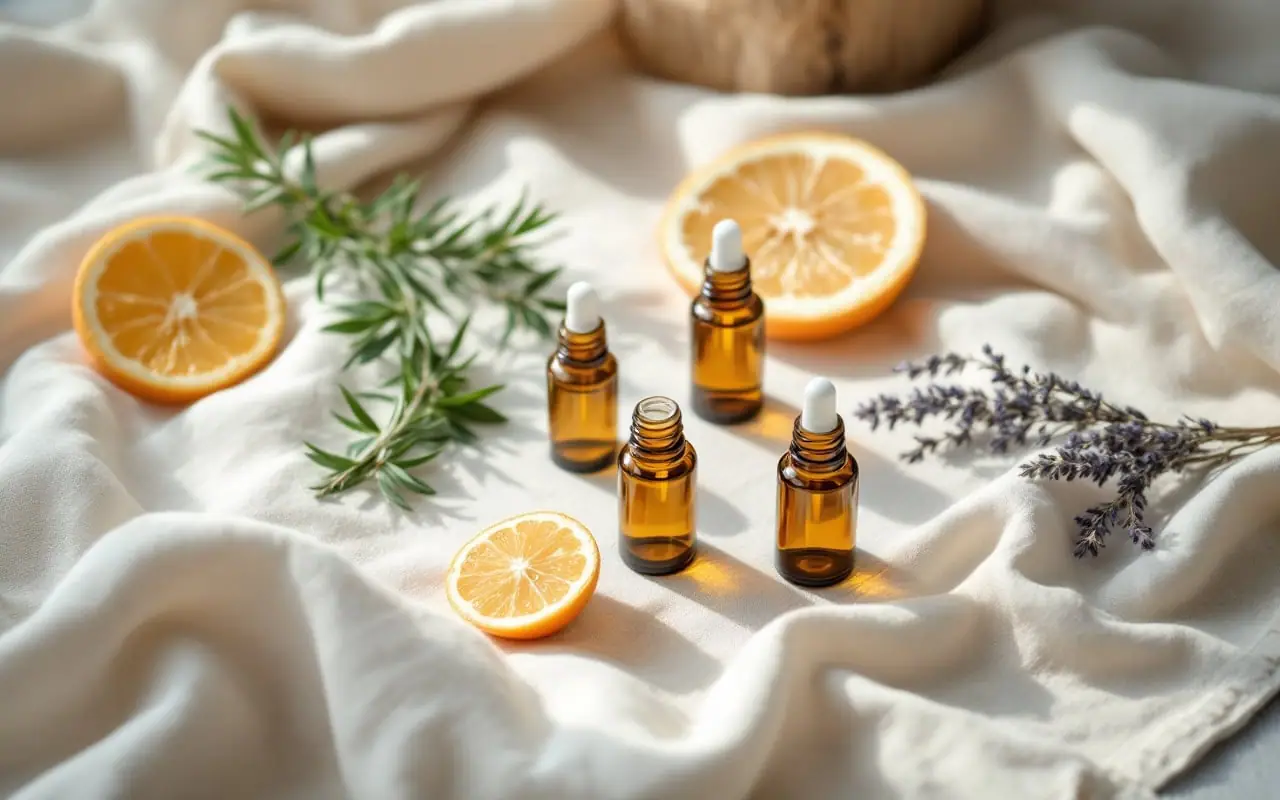
Good blends depend less on rare oils than on good neighbours. Oils that share something, a green edge or a warm sweetness, slide together into one scent. Oils with nothing in common tend to sit side by side and argue. The scent-family wheel is a simple way to guess which is which before you open a bottle.
The scent-family wheel
Picture seven families arranged in a ring. Each blends most easily with the families on either side of it. The guide to what essential oils smell like describes each family in more detail.
| Family | Typical oils | Next door on the wheel |
|---|---|---|
| Citrus | Sweet orange, lemon, bergamot, mandarin, grapefruit | Floral, herbal |
| Herbal | Rosemary, peppermint, clary sage, marjoram | Citrus, trees and woods |
| Trees and woods | Atlas cedarwood, cypress, juniper berry, pine, eucalyptus | Herbal, spice |
| Spice | Black pepper, ginger, cardamom, coriander seed | Trees and woods, resin |
| Resin | Frankincense, myrrh, benzoin, elemi | Spice, exotic and earthy |
| Exotic and earthy | Ylang ylang, sandalwood, patchouli, vetiver, palmarosa | Resin, floral |
| Floral | Lavender, geranium, rose, roman chamomile, neroli | Exotic and earthy, citrus |
Read down the table and you travel all the way round: citrus, herbal, woods, spice, resin, exotic and earthy, floral, and back to citrus.
Three rules from the wheel
- Neighbours blend easily. Citrus with floral, resin with spice, woods with herbal: these rarely go wrong.
- A single family is safe but can be flat. Cypress and juniper are pleasant together, but a little citrus or spice gives the blend more shape.
- Families far apart on the wheel need a bridge. Rosemary (herbal) and ylang ylang (exotic) tend to clash. Add an oil that sits between them, or has a foot in both camps, and they start to get along. Lavender (floral with a herbal side), clary sage (herbal with a musky side) and bergamot (citrus with a floral side) are the most useful bridges. In practice citrus gets on with almost every family, which is why so many blends contain one.
Drop counts for a 10 ml roller
Using the usual rule of thumb that 20 drops make about 1 ml (droppers vary), a 10 ml roller takes 2 drops of essential oil at 1 percent and 4 drops at 2 percent. One percent suits daily use, sensitive skin and older adults; 2 percent is a normal strength for short-term use on adults. The dilution chart covers other bottle sizes and uses.
Two drops cannot be split three ways, and one drop each of a strong oil and a mild one leaves the strong one in charge. The answer is a stock bottle. Mix the neat oils in the right ratio in a clean, empty dropper bottle, shake it, label it, and take 2 drops of the mix for a 1 percent roller or 4 drops for 2 percent. For a 3:1 pair, put in 6 drops and 2 drops. For the 2:1:1 blends below, use 8, 4 and 4 drops, which is enough for eight rollers at 1 percent or four at 2 percent. Keep stock bottles tightly closed and out of reach of children. To work out ratios for other oils, the blending factors give a starting point.
Eight pairings that work
| Pairing | Families | 2 percent (4 drops) | 1 percent (2 drops) | What it is like |
|---|---|---|---|---|
| Sweet orange + lavender | Citrus, floral | 2 + 2 | 1 + 1 | Soft and clean, a good first blend |
| Bergamot FCF + geranium | Citrus, floral | 2 + 2 | 1 + 1 | Rosy and bright |
| Lemon + rosemary | Citrus, herbal | 2 + 2 | 1 + 1 | Sharp and green, like a kitchen garden |
| Rosemary + Atlas cedarwood | Herbal, woods | 2 + 2 | 1 + 1 | Fresh leaves over dry wood |
| Cypress + juniper berry | Woods, woods | 2 + 2 | 1 + 1 | Forest air; add citrus if it feels flat |
| Frankincense + black pepper | Resin, spice | 3 + 1 | 2 drops of a 3:1 stock | Warm, peppery incense |
| Sandalwood + frankincense | Exotic, resin | 3 + 1 | 2 drops of a 3:1 stock | Quiet, creamy and long-lasting |
| Lavender + vetiver | Floral, exotic | 3 + 1 | 2 drops of a 3:1 stock | Lavender over a smoky, rooty base |
The lemon here is ordinary cold-pressed lemon, which can make skin burn in sunlight at higher levels. Two drops in 10 ml is 1 percent, under the 2 percent ceiling that safety references give for skin that will see the sun. Vetiver is thick, so warm the bottle in your hand and let each drop form slowly.
Four three-oil blends
Three of these are chains of neighbours, with the middle oil linking the other two. The evening blend stays within two neighbouring families.
| Blend | Oils (families) | 2 percent (4 drops) | 1 percent (2 drops) |
|---|---|---|---|
| Quiet evening | Lavender (floral), mandarin (citrus), roman chamomile (floral) | 2 + 1 + 1 | 2 drops of an 8 + 4 + 4 stock |
| Morning desk | Lemon (citrus), rosemary (herbal), Atlas cedarwood (woods) | 2 + 1 + 1 | 2 drops of an 8 + 4 + 4 stock |
| Rose and wood | Bergamot FCF (citrus), geranium (floral), sandalwood (exotic) | 2 + 1 + 1 | 2 drops of an 8 + 4 + 4 stock |
| Winter warmth | Atlas cedarwood (woods), black pepper (spice), frankincense (resin) | 2 + 1 + 1 | 2 drops of an 8 + 4 + 4 stock |
Skip the roman chamomile if plants in the daisy family give you allergies. Drop counts follow the order the oils are listed in, so the morning desk blend at 2 percent is lemon 2, rosemary 1 and cedarwood 1.
Testing a blend on paper strips
- Label one smelling strip per oil in pencil and dip each to the same depth, about half a centimetre.
- For an oil that will get two drops in the blend, use two strips.
- Hold all the strips together in a fan a few centimetres below your nose and sniff gently.
- Take the strips away one at a time. If the blend improves when one goes, that oil is the problem, or there is too much of it.
- Smell again after 15 minutes and after an hour, when the top notes have faded and the base is showing.
- When you like it, mix a small trial in a stock bottle, leave it overnight and smell it again on a fresh strip before you dilute it.
- Write down the oils, drops, date and what you noticed.
How a blend changes over a few days
A freshly mixed blend often smells sharp and a little disjointed, with each oil still recognisable. Over the next day or two the edges soften and the oils begin to read as one scent, which is why many home blenders wait at least 24 hours before judging. Over the following weeks, especially in a bottle that is opened often, the brightest top notes fade first, so the blend drifts towards its middle and base notes. After a few months oxidation sets in, above all in citrus and pine oils: the scent turns flat or harsh, and the oil becomes more likely to irritate skin. Make small batches, store them in dark glass somewhere cool, and use a roller blend within a few months.
Using your rollers safely
These rollers are meant for adults, on pulse points such as the wrists, away from the eyes and broken skin. Patch test each new blend on your inner forearm and wait 24 hours before using it more widely. Rosemary is best avoided in pregnancy, with epilepsy and around small children, and anyone who is pregnant, has asthma or epilepsy, takes regular medicines or wants to use a blend on a child should ask a doctor, midwife or pharmacist first. If your skin reacts, wash it with mild soap and water and stop using that blend. Swelling of the face or lips, or trouble breathing, needs emergency help.