Aroma Corner
essential oils at home, with care
Aromatherapy for complete beginners: a short course in six lessons
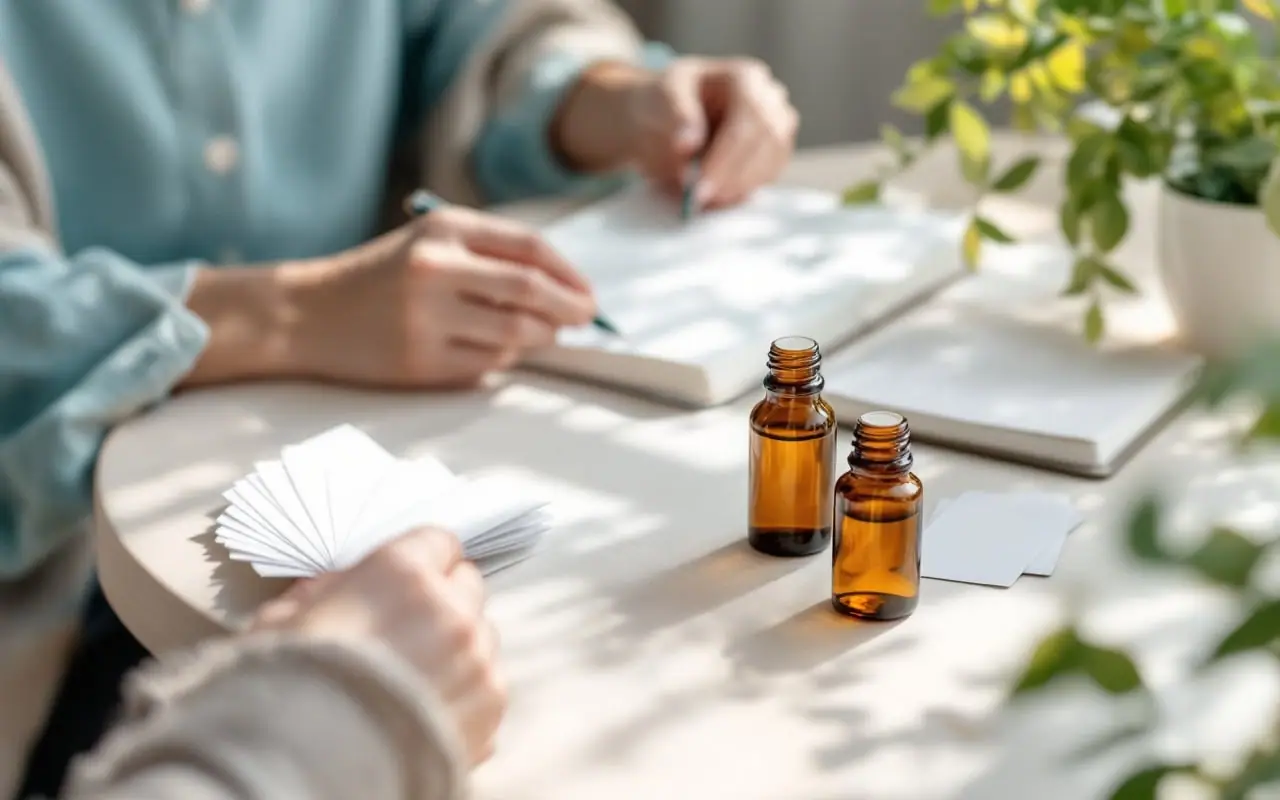
Most people meet aromatherapy sideways. A friend gives you a lavender pillow spray, or you buy a bottle of orange oil because the shop smelled nice. Then the questions start. Is this medicine? Can it go on skin? Why does one small bottle cost five times as much as the next?
This short course is for that moment. It assumes you know nothing and own one bottle at most. Each of the six lessons ends with one small task you can do at home with a tissue, a notebook or your own nose. If you would rather see the whole picture first, the hub page on aromatherapy at home sets out the main methods side by side.
Lesson 1: What aromatherapy is, and what it is not
Aromatherapy is the use of essential oils for comfort, mood and a sense of wellbeing, mostly by smelling them or by applying them well diluted to the skin. An essential oil is a concentrated mix of the aromatic compounds a plant makes, usually steam-distilled from flowers, leaves, wood or resin, or pressed from citrus peel. Some plants give up their oil easily and some yield very little, which is the main reason rose costs so much more than lavender.
The word was coined in France in the early twentieth century, but the habit is far older. Japan has its own scent traditions: kodo (the formal art of appreciating incense), tubs of fragrant hinoki cypress, and yuzuyu, whole yuzu fruit floating in the bath on the winter solstice.
What aromatherapy is not: a replacement for medical care. Essential oils are not medicines you take. In Japan they are normally sold as general goods, and sellers may not claim they treat anything. A scent you enjoy at the end of a long week, or a slow hand massage for an older parent, is a real benefit. It is also a modest one, and honest aromatherapy describes it in modest terms.
Small task: find any essential oil you own, or the scented product closest to one, and read the label. Look for the plant's Latin name, the words "essential oil", and any warnings. Note which are missing.
Lesson 2: How smell reaches the brain
When you sniff an oil, airborne molecules drift to the roof of your nasal cavity, where a small patch of tissue holds millions of smell-sensing nerve cells. Each cell carries one type of receptor, and humans have roughly 400 working types; the scientists who found the genes behind them shared the 2004 Nobel Prize in Physiology or Medicine. One scent molecule fits several receptors and each receptor answers to several molecules, so your brain reads a pattern. That is how you can tell lemon from lime without being able to say why.
From the nose, signals pass to the olfactory bulb and then reach the brain's emotion and memory areas more directly than signals from sight or hearing. Structures such as the amygdala and hippocampus, often grouped as the limbic system, are only a short step away. That short route is why one breath of a certain soap can put you back in a grandparent's bathroom.
Now the honest part. A direct line to emotion does not mean a scent will do what a label promises. How you respond depends heavily on whether you like the smell, what you expect, and what it reminds you of. Lavender may settle someone who loves it and irritate someone who links it with a hospital corridor. Reviews of aromatherapy for anxiety, sleep and pain have found some small positive effects, but many studies are small, short and hard to blind, because people can smell which oil they are getting. The US National Center for Complementary and Integrative Health sums up the evidence in similar terms. A small amount of what you breathe in or rub on also reaches the bloodstream, which is one reason for the next lesson.
Small task: pick one smell from your kitchen, such as coffee, a cut lemon or toasted sesame oil. Close your eyes, breathe it in, and write down the first memory or place that comes to mind.
Lesson 3: Safety basics
Most problems at home come from a handful of predictable mistakes. These seven habits cover most of the risk.
- Never swallow essential oils or add them to food or drinks. Keep bottles capped and out of children's reach; even a small amount swallowed can be dangerous for a child.
- Dilute before anything touches skin. For adults, 1 to 2 percent is a common range for body use: roughly 1 drop in 5 ml of carrier oil gives 1 percent, 2 drops give 2 percent. Use 1 percent or less on the face. Drop sizes vary, so the dilution chart is worth keeping handy.
- Patch test a new oil on the inside of your forearm and wait 24 hours. If the skin turns red, itches or swells, wash it with mild soap and water and do not use that blend again.
- Keep oils away from your eyes and the inside of your nose. If oil gets in an eye, rinse with plenty of clean, lukewarm water for several minutes, and get medical advice if pain or blurred vision continues.
- Cold-pressed bergamot, lime, lemon, grapefruit and bitter orange can make skin burn in sunlight. Keep them off skin that will see the sun within about 12 hours. Sweet orange and mandarin carry a low risk.
- Take extra care during pregnancy, around babies, young children and older people, with epilepsy or asthma, and with pets, cats in particular. If any of these apply, or you take regular medicines, ask a doctor, midwife or pharmacist first.
- Store oils in dark glass, caps tight, somewhere cool and away from flames. Oxidised oil is more likely to irritate skin; a common rule of thumb is to finish citrus oils within a year of opening and most others within two to three.
If someone swallows an oil, do not make them vomit. Call a doctor, a poison information service or emergency services straight away. In Japan, the Japan Poison Information Center runs a public advice line.
Small task: give your oils a proper home, such as a lidded box on a high shelf away from the stove and direct sun, and write the opening date on each bottle.
Lesson 4: Finding scents you like
In home aromatherapy, liking a scent matters more than anything a book says about it. A smell you dislike will not relax you. Start with three to five oils chosen by your own nose. These six are easy for most beginners to live with.
| Oil | Botanical name | What it smells like | An easy first use |
|---|---|---|---|
| Lavender | Lavandula angustifolia | Soft, floral, a little herbal | A tissue at bedtime |
| Sweet orange | Citrus sinensis | Like peeling an orange | A daytime diffuser |
| Atlas cedarwood | Cedrus atlantica | Dry wood, pencil shavings | Evening diffuser, with orange |
| Peppermint | Mentha x piperita | Sharp and cool | One breath from a tissue (not near young children's faces) |
| Geranium | Pelargonium graveolens | Rosy and green | A diluted hand oil |
| Hinoki | Chamaecyparis obtusa | Clean wood, like a new bath tub | The bath, with a dispersant |
Buy small bottles (5 or 10 ml). A good label gives the common and Latin names, the part of the plant, the extraction method and the country of origin. Be wary of "fragrance oil" or "aroma oil": in Japan, products sold as "aroma oil" are sometimes synthetic or already diluted, and the word to look for is seiyu (essential oil). Very cheap rose or sandalwood is a reason for doubt.
To smell an oil, put a drop on a paper strip (unscented coffee filter paper works) rather than sniffing the bottle neck, and take short sniffs a few centimetres from your nose. Your nose tires quickly, so rest between oils. The page on scent profiles describes fifteen popular oils in plain words.
Small task: smell up to five oils on paper strips in one sitting, score each from 1 to 5 and add a few words. Keep the two you scored highest.
Lesson 5: Your first three uses
None of these puts oil directly on skin.
A tissue
Put 1 or 2 drops on a tissue and hold it a few centimetres below your nose for a few breaths, then fold it away. Throw it out afterwards rather than leaving it where a toddler or a dog might chew it.
A diffuser
For an ultrasonic diffuser, follow the maker's instructions; many suggest about 3 to 5 drops per 100 ml of water. Run it for 30 to 60 minutes, then switch it off and air the room. If you get a headache or a scratchy throat, stop. Do not diffuse in a closed room a baby or pet cannot leave, and take care if anyone in the house has asthma.
A bath, with a dispersant
Oil floats on water, and neat drops can sting skin. Mix 3 to 5 drops into a tablespoon of unscented liquid soap or bath base first, then stir it in just before you get in. Carrier oil keeps the essential oil diluted but does not disperse it, and makes the tub slippery. Leave peppermint, clove, lemongrass and most citrus oils out of the bath while you are learning.
In a Japanese home the family often shares one tub of water, so remember the next person in may be a small child. If your bath has a reheating (oidaki) system, check the manual first, as some makers advise against certain additives. Keep the water warm rather than hot, especially on winter evenings or if you have heart or blood pressure problems. For a hand or foot bath, mix 1 to 3 drops into a teaspoon of dispersant in a basin of warm water and soak for ten minutes.
Small task: try one of the three methods once this week, with a single oil. Note how many drops you used and how long you could still smell it.
Lesson 6: Keeping a scent notebook
After a month of notes you will know which oils you actually reach for and whether anything gives you a headache or an itch. Note the date, the oil and drops, the method, why you used it, how it smelled at first and later, and anything unpleasant. At the back, keep one line per bottle with the Latin name, where you bought it and the date you opened it.
| Date | Oil and drops | Method | Notes |
|---|---|---|---|
| 12 Nov, 9 pm | Lavender, 2 | Tissue | Pleasant for 10 minutes, slept as usual |
| 16 Nov, 8 pm | Hinoki, 4 in bath base | Bath | Woody, calming, slight tingle on shins, use 3 next time |
Smell the same oil again after a few months and compare notes. Citrus oils in particular turn flat or slightly sharp as they age.
Small task: start the notebook today with one entry, even if it is only the kitchen smell from lesson 2.
After the six lessons
When you want to go further, the essential oil dictionary lists common oils with their cautions, and blending is a natural next step.
Aromatherapy should feel pleasant. If an oil gives you a headache, a rash, wheezing or nausea, stop, open a window and wash any skin it touched. See a doctor if a rash spreads or blisters, if breathing trouble does not settle quickly, or if anyone has swallowed oil. And if what brought you here was a health problem, such as weeks of poor sleep, low mood or pain that keeps returning, talk to a doctor about that too. A scent you enjoy can sit alongside proper care, but it cannot stand in for it.