Aroma Corner
essential oils at home, with care
How essential oils and other aromatics are extracted
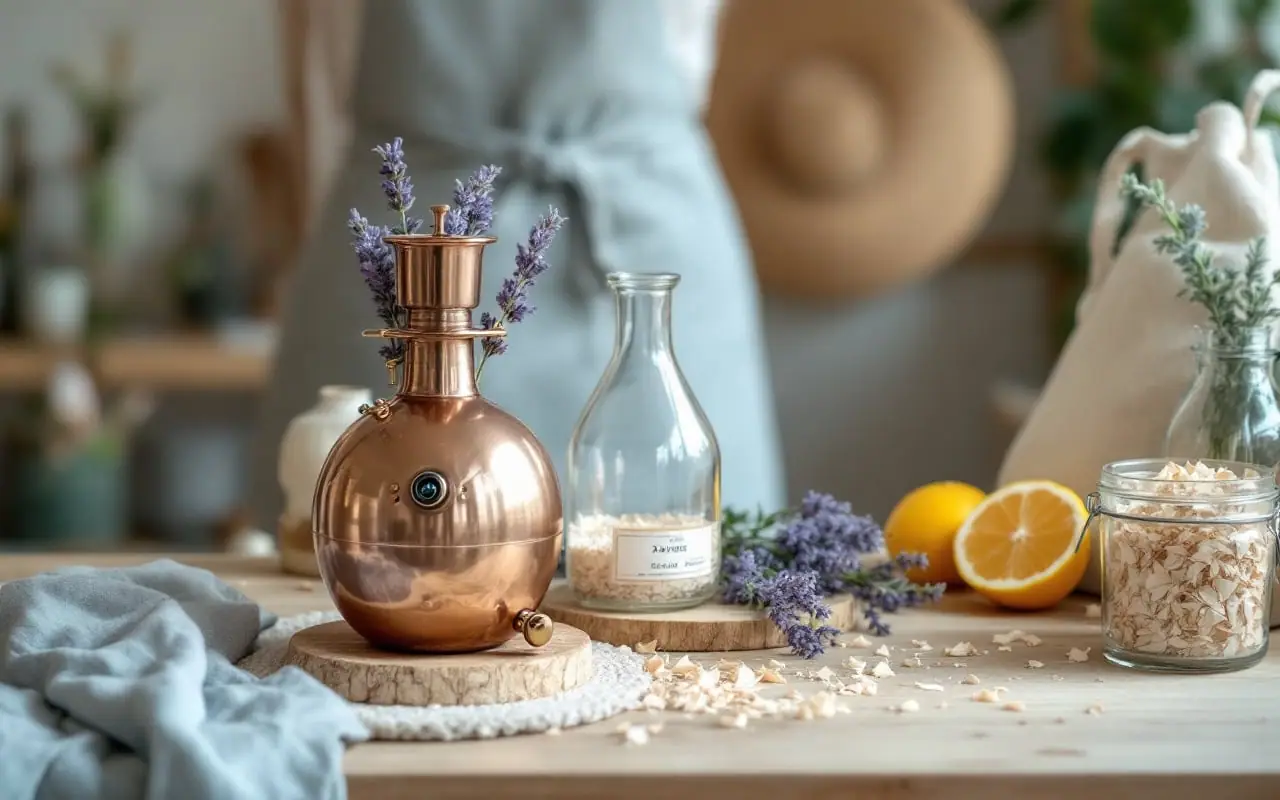
Rose otto, rose absolute and rose CO2 extract all come from the same flower, yet they smell different, cost different amounts and carry different cautions. The difference lies in how the scent was taken out of the plant. Strictly, the international standard ISO 9235 keeps the term "essential oil" for products made by distillation or, for citrus peel, by mechanical pressing. Absolutes, CO2 extracts and infused oils are related but separate products, and a good label says which.
Steam distillation
Most essential oils are made this way. Plant material sits on a grid inside a still and steam is passed up through it. The heat and moisture burst the tiny oil glands, and the aromatic molecules travel with the steam into a cooled coil, where everything condenses back into liquid. The oil then separates from the water; most oils float, though a few, such as clove, sink.
Lavender, peppermint, eucalyptus, tea tree, rosemary and most wood oils are steam distilled. So is hinoki (Japanese cypress), distilled in Japan, often from offcuts and sawdust left over from timber work; it smells like a new cypress-wood bath.
The water left behind is the hydrosol, also called a hydrolat or floral water, as in rose water and lavender water. It holds a small amount of dissolved aromatic compounds, so it smells like a soft, slightly green version of the oil and is far milder. Hydrosols are not sterile and can grow mould or bacteria: keep them in the fridge, use them within months of opening and throw out any that turn cloudy or smell off. Only use one in food if it is sold as food.
Water distillation
Here the plant material is fully immersed in water that is brought to the boil, instead of sitting above it. This suits material that would clump into a solid mass in steam, such as rose petals. Rose otto from Bulgaria and Turkey is traditionally made this way, with the distillation water often run through the still again to recover more oil.
Expression (cold pressing)
Citrus oil sits in small sacs in the coloured outer layer of the peel, so it can be pressed out without heat. Modern machines rasp or prick the fruit, rinse the released oil away with a spray of water and separate it in a centrifuge. The result is labelled cold-pressed or expressed. It smells most like fresh fruit, but it also carries heavier, non-volatile compounds from the peel. In some citrus oils these include furanocoumarins such as bergapten, which can make skin burn, blister or darken in sunlight. Cold-pressed bergamot, lime, lemon, grapefruit and bitter orange are the main culprits; sweet orange and mandarin are low risk. Expressed citrus oils also oxidise quickly.
Japan's own citrus oil is yuzu, from a small, bumpy, intensely fragrant fruit grown mainly in Kochi and Tokushima on the island of Shikoku. Yuzu oil is sold both cold-pressed and distilled, and the pressed oil smells closer to fresh peel. Ask the supplier whether a cold-pressed batch has been checked for phototoxic compounds, and if in doubt keep it off skin that will see the sun. The whole fruit goes into the bath on the winter solstice, a custom called yuzuyu.
Solvent extraction: concretes, absolutes and resinoids
Some flowers, including jasmine and tuberose, give little or no usable oil in a still, and heat spoils their scent. Instead the petals are washed with a solvent, most often hexane, which is then evaporated off to leave a waxy, fragrant solid called a concrete. Stirring the concrete with alcohol and chilling it makes the plant waxes drop out; once the alcohol is removed, what remains is the absolute: thick, deeply coloured and very intense. Rose absolute is made this way, which is why it smells richer and more honeyed than rose otto.
Producers remove the solvent carefully, and most absolutes go to perfumery. Resinoids are the equivalent for resins such as benzoin and labdanum. Benzoin resinoid is usually sold dissolved in another liquid, which the label should name.
Enfleurage
This is the historic method for delicate flowers. Glass plates in wooden frames were spread with purified, odourless fat, and fresh jasmine or tuberose flowers were pressed into it and replaced every day or so until the fat was saturated with scent. That scented fat, the pomade, was then washed with alcohol to give an absolute. Perfumers in Grasse in southern France used it into the twentieth century; today it survives mostly as a craft.
Maceration and infused oils
To make an infused (or macerated) oil, dried plant material is steeped in a carrier oil such as sunflower or olive oil, often with gentle warmth, for a few weeks and then strained. Calendula, St John's wort and arnica are common examples. An infused oil carries some of the plant's colour and oil-soluble compounds but is nowhere near as concentrated as an essential oil, so it is used as a carrier, not counted in drops. Arnica oil is for unbroken skin only.
CO2 extraction
Under high pressure, carbon dioxide becomes a liquid or, above about 31 degrees Celsius, a "supercritical" fluid that dissolves aromatic compounds without much heat. When the pressure is released the CO2 turns back into gas and escapes, leaving no solvent behind. "Select" extracts are lighter and closest to an essential oil; "total" extracts also carry waxes and colour and can be thick or solid. CO2 extracts often smell more like the living plant: ginger CO2 smells like freshly cut root. Their chemistry differs from the distilled oil of the same plant, so safety information for one does not automatically apply to the other.
The methods side by side
| Method | Typical plants | Name on the label | Notes |
|---|---|---|---|
| Steam distillation | Lavender, peppermint, eucalyptus, hinoki | Essential oil; hydrosol as a co-product | The most common method |
| Water distillation | Rose petals | Essential oil ("rose otto") | Plant fully immersed in boiling water |
| Expression | Orange, lemon, bergamot, grapefruit, yuzu | Essential oil, "cold-pressed" or "expressed" | Some are phototoxic; oxidises quickly |
| Solvent extraction | Jasmine, tuberose, rose | Concrete, then absolute | Mainly perfumery; possible solvent traces |
| Solvent extraction of resins | Benzoin, labdanum | Resinoid | Often sold dissolved in another liquid |
| Enfleurage | Jasmine, tuberose | Pomade, absolute | Historic, rare today |
| Maceration | Calendula, St John's wort, arnica | Infused or macerated oil | A carrier oil, not an essential oil |
| CO2 extraction | Ginger, frankincense, calendula, vanilla | CO2 extract, "select" or "total" | No solvent residue; different chemistry |
Why the method matters for safety
- Sun sensitivity comes mainly from cold-pressed citrus. Distillation leaves the heavy furanocoumarins behind, so distilled lime or lemon is generally not phototoxic, and "bergamot FCF" has them removed. If you use a phototoxic oil on skin above its safe level, keep that skin out of the sun for 12 hours.
- Absolutes can hold tiny traces of solvent and cause skin allergy more often than most distilled oils, so keep them for inhalation or very low strength on skin.
- Costly oils are often sold pre-diluted, for example "rose absolute 5% in jojoba". Ten drops of that contain half a drop of absolute, which matters when you work out a blend.
- A bottle called "lavender oil" might be an essential oil, an infused oil or a synthetic fragrance oil. The label should make clear which.
How to read a label
A good bottle tells you:
- The common name and the botanical name, for example Lavandula angustifolia rather than just "lavender". The essential oil dictionary lists both for common oils.
- The part of the plant: flower, leaf, peel, wood, root or resin.
- The method: steam distilled, cold-pressed, absolute, or CO2 select or total.
- The country of origin, and the chemotype where it matters (rosemary, thyme). Both help explain why the same oil can smell different from bottle to bottle.
- Whether it is diluted, and in what.
- A batch number and a best-before or distillation date. Good suppliers can show a gas chromatography report for each batch.
Be wary of "fragrance oil", "aroma oil" or "perfume oil", which are often synthetic: fine for candles, but not the same thing. Be wary of health claims too. In Japan essential oils are generally sold as general goods (zakka), so a label or shop card promising to treat a condition is a red flag; the guide to the laws that matter in Japan explains why.
A safety note on every method
Whatever the method, what is in the bottle is concentrated plant chemistry. Dilute it for skin, keep it out of eyes and away from children and pets, and never swallow it. If a child swallows an essential oil, call a doctor or a poison information service straight away (in Japan, the Japan Poison Information Center) and do not make them vomit. A blistering or darkening rash after using citrus oil in the sun also deserves a visit to a doctor or pharmacist.