Acupressure mats: what they do and how to choose one
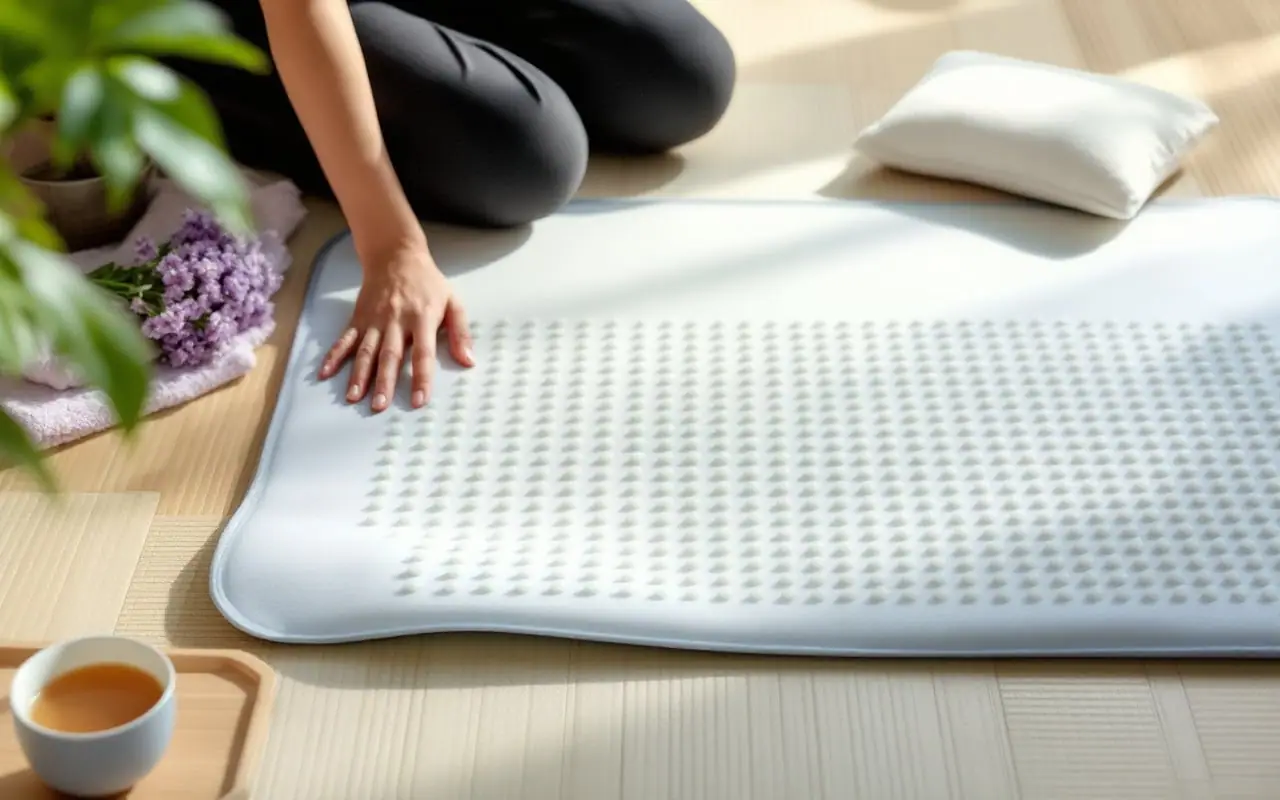
An acupressure mat is a foam pad covered in a few thousand small plastic points, set out in little rosettes. You lie on it, it stings for a couple of minutes, and then, for a lot of people, it settles into a warm, tingly, oddly relaxing feeling. This guide is for anyone wondering whether one is worth having for a tense back or shoulders, and what to look for if you buy one. The short answer is that an acupressure mat is a relaxation tool with modest, uncertain effects on pain. When choosing, what matters most is how sharp it feels, how big it is, what it is made of and whether you want a pillow.
A note: links to Amazon here are affiliate links. As an Amazon Associate I earn from qualifying purchases.
If you only get one
An acupressure mat with a pillow
A spiked foam mat plus a neck pillow; start with a thin shirt on and about ten minutes.
View on AmazonOr, if it suits you better: a firm foam roller on Amazon.
When I was doing sports massage in Yorkshire, clients would sometimes ask me about these mats, usually in the tone people use when they suspect they are about to be told off. My answer then is much the same as my answer now from Kitakyushu. They are not magic, and they are not nonsense either.
What an acupressure mat does, and doesn't
The name is a little generous. Acupressure, as practised in traditional East Asian medicine and in Japanese shiatsu (finger-pressure massage), means pressing on particular points, tsubo in Japanese, with the fingers or thumbs. A mat does not find particular points. It presses on everything at once.
What you feel is a lot of small, sharp pressures that the nervous system cannot ignore. Within a few minutes the sting usually fades, the skin under the mat reddens and warms as more blood flows to it, and many people feel their muscles let go. There are a couple of plausible explanations. One is the "gate control" idea from pain science: a busy stream of harmless signals from the skin can turn down how strongly the nervous system passes on aching signals from deeper down, which is also why rubbing a knocked elbow helps. The other is simply that the mat makes you lie still for twenty minutes, breathing slowly, without a phone, and that is relaxing in its own right.
As for evidence, there is not much. The few small trials of acupressure mats, mostly in people with long-standing neck or lower back pain, have reported modest short-term improvements in pain or relaxation. But nobody can be blinded to whether they are lying on spikes, the groups were small and short, and few compared the mat with another restful way of lying down. That is not enough to say the mat itself does the work. Research on acupressure done by hand on chosen points is larger but of mixed quality; the US National Center for Complementary and Integrative Health keeps plain summaries of acupuncture and related approaches on its website.
What a mat will not do is cure anything, fix your posture, burn fat, flush out "toxins" or improve circulation around the whole body. A box that promises any of that is telling you more about its marketing than about its spikes.
Who might like one
- People with general muscle tension across the upper or lower back who enjoy firm massage.
- People who struggle to switch off in the evening and want a reason to lie still for a while.
- People on their feet all day who like resting their soles on something knobbly. This has a Japanese echo: the split bamboo foot stepper, takefumi, and the pebble paths for walking barefoot over foot pressure points, ashitsubo paths, found in some parks and onsen towns, have been around far longer than spiked mats.
If your problem is a stiff upper back from desk work, a mat will feel pleasant and do little about the cause. The routine in how to fix your posture will do more. If it is the classic tight band across the tops of the shoulders, the stretches and warmth in the piece on katakori are the better first step.
Who should not use one
Check with a doctor first, or simply leave the mat alone, if any of these apply:
- Pregnancy. Most makers advise against using one, partly because traditional teaching says some pressure points should be avoided in pregnancy. There is no good evidence either way, which is reason enough to wait.
- Diabetes with nerve damage (peripheral neuropathy), or anything else that dulls feeling in the skin. You may not notice the skin being damaged, and it may heal slowly. Never stand on a mat with numb feet.
- Blood thinners or a bleeding disorder. You are more likely to bruise, and any broken skin will bleed for longer.
- Skin problems where the mat would go: a flare of eczema or psoriasis, broken or fragile skin, cuts, infections, rashes, sunburn, varicose veins or recent scars.
- Recent surgery, a recent injury or a fracture in the area.
- Low blood pressure or a tendency to faint, especially when getting up after lying down for a while.
- A fever, or feeling generally unwell.
Some makers also list epilepsy, heart conditions and cancer treatment. If you are being treated for anything serious, ask your doctor or physiotherapist before you start. Keep the mat rolled up and out of reach of small children and pets.
What matters when choosing
- How intense it feels. More points packed closer together spread your weight and feel milder; fewer, sharper or longer points feel stronger. Some makers sell a gentler version with blunter points for beginners or sensitive skin. If you have never used one, start on the mild side.
- Size. A standard mat covers the back from the shoulders to the lower back. Taller people, or anyone who wants the hips and legs included, need a longer one. Small pads suit the feet, the seat of a chair or a suitcase.
- The base and cover. Most mats are a foam pad inside a cotton or linen cover with the plastic rosettes sewn on. Thicker, denser foam feels firmer and keeps its shape longer. A cover that comes off for washing is worth having, because the mat meets bare skin.
- Materials. The points are usually a hard plastic, often ABS. Look for a maker that says what the plastic is, and expect a new mat to smell a little; a day or two of airing usually sorts that out. Some mats use coconut fibre or another plant fibre instead of foam.
- Pillow or no pillow. A matching spiked pillow lets you work on the back of the neck, which some people love and others find far too much. It can also set your head at the wrong height for you, and a folded towel under the head does the job for many people.
- Claims on the box. Skip anything that promises to cure, slim, cleanse or treat. A sensible maker tells you how to use the mat and who should not.
The options
How to use one without regretting it
- Start on a bed or sofa, or with a thin T-shirt between you and the points. The bare floor is the strongest setting, so save it for later.
- Sit on the edge of the mat, then lower yourself slowly onto your back so your weight spreads across many points at once. Do not shuffle about once you are down; that is how skin gets scratched.
- Breathe slowly. The first one to three minutes are the prickly part.
- Begin with 5 to 10 minutes. Build up over a couple of weeks to the 20 minutes or so that many makers suggest as a usual session.
- To get up, roll onto your side and push up with your arms, then sit for a moment before you stand, especially if you have been very relaxed.
- Expect red dots that fade within an hour or two. The points should never break the skin. Broken skin, bruising, or a rash that lingers means stop.
- Wipe the points and wash the cover now and then, and do not share a mat with anyone who has a skin infection.
A mat and a roller are different tools. The mat is for lying still and letting go. If your aim is to loosen a stiff upper back between strength sessions, a high-density foam roller on Amazon is the more useful choice, because you move on it, slowly working along the back or the thighs, and it slots naturally into an exercise routine. If you only have room for one and your back stiffens at a desk, the roller earns its space more readily.
When to see someone instead
A mat is for ordinary muscle tension. See a doctor or physiotherapist rather than reaching for the spikes if back or neck pain comes with numbness, tingling or weakness in an arm or leg, follows a fall or injury, wakes you at night and does not ease when you change position, or comes with a fever or weight loss you cannot explain. Loss of bladder or bowel control, or numbness around the groin or buttocks, is an emergency: call an ambulance (119 in Japan, 999 in the UK, 911 in the US). And if you have used a mat regularly for a few weeks and the pain is no better, that is a useful answer too. The mat is not the right tool for this one, and someone should take a proper look.
How this guide was put together
The options above are drawn from product specifications, materials, maker information and other published information about acupressure mats. We have not tried any of these products ourselves, and we do not rank them. The links point to examples of each type, so check the size, the point style and the cover against the list above before you buy.

The writer
Tom worked as a sports-massage therapist in Yorkshire before moving to Kitakyushu. He writes about stiff shoulders, backs, desks and floor sitting, in plain words and without selling you a gadget.