How to fix your posture: habits and exercises that help
If you want to know how to fix your posture, here is the short version from someone who spent years looking at people's backs for a living: stop trying to hold yourself straight, and start moving more often and getting a bit stronger. Pinning your shoulders back by willpower lasts about as long as a New Year's resolution. Small habits, a ten-minute routine a few times a week and a desk that is not fighting you will do far more.
In Japan the everyday word for a slouch is nekoze, "cat back", and it is said with the same mild disapproval my grandmother used for "sit up straight". Both of them had a point. Both of them also missed one, which is that posture matters less than people are told and movement matters more.
What bad posture actually means
"Bad posture" usually describes a handful of familiar shapes: the head pushed forward of the shoulders, a rounded upper back, shoulders that roll forward, or a lower back that sways with the hips tipped forward. Most of us drift into at least one of them by the end of a long day.
Here is the part that surprises people. Research has not found a strong, simple link between any of those shapes and pain. People with textbook posture get sore backs, and plenty of slouchers never do. The spine is tough and adaptable, and no single position will damage it. What seems to matter more is how long you stay in one position, how strong and fit you are, how well you sleep and how stressed you are.
So fixing your posture is less about finding the one correct shape and more about three things:
- Changing position often, so no muscle or joint carries the same load for hours.
- Building strength where it holds you up: the upper back, shoulders, trunk and hips.
- Arranging your desk, car and sofa so that a comfortable upright position is the easy option.
A two-minute posture check
You do not need an assessment to see your habits. Two quick checks will do.
The wall test: stand with your heels a few centimetres from a wall and let your bottom and shoulder blades touch it. Notice where your head ends up. If the back of your head sits well away from the wall and bringing it back without tipping your chin up feels like hard work, your head has been living forward.
The side photo: ask someone to take a photo of you from the side while you work, without warning, in the middle of the afternoon. It is more honest than any mirror.
Neither is a diagnosis. They just show you which way you drift, which tells you where to aim the exercises below. If one shoulder or hip sits clearly higher than the other and you have never noticed it before, or you cannot straighten up at all, show it to a doctor.
A note: links to Amazon here are affiliate links. As an Amazon Associate I earn from qualifying purchases.
A small help with this: flat resistance bands on Amazon. A few more ideas sit at the end of this note.
Habits that do more than willpower
The most useful posture habit is also the least interesting: get up. Change position at least every half hour and leave your chair every hour, even for a minute. Take phone calls standing, use the stairs, walk to the far printer.
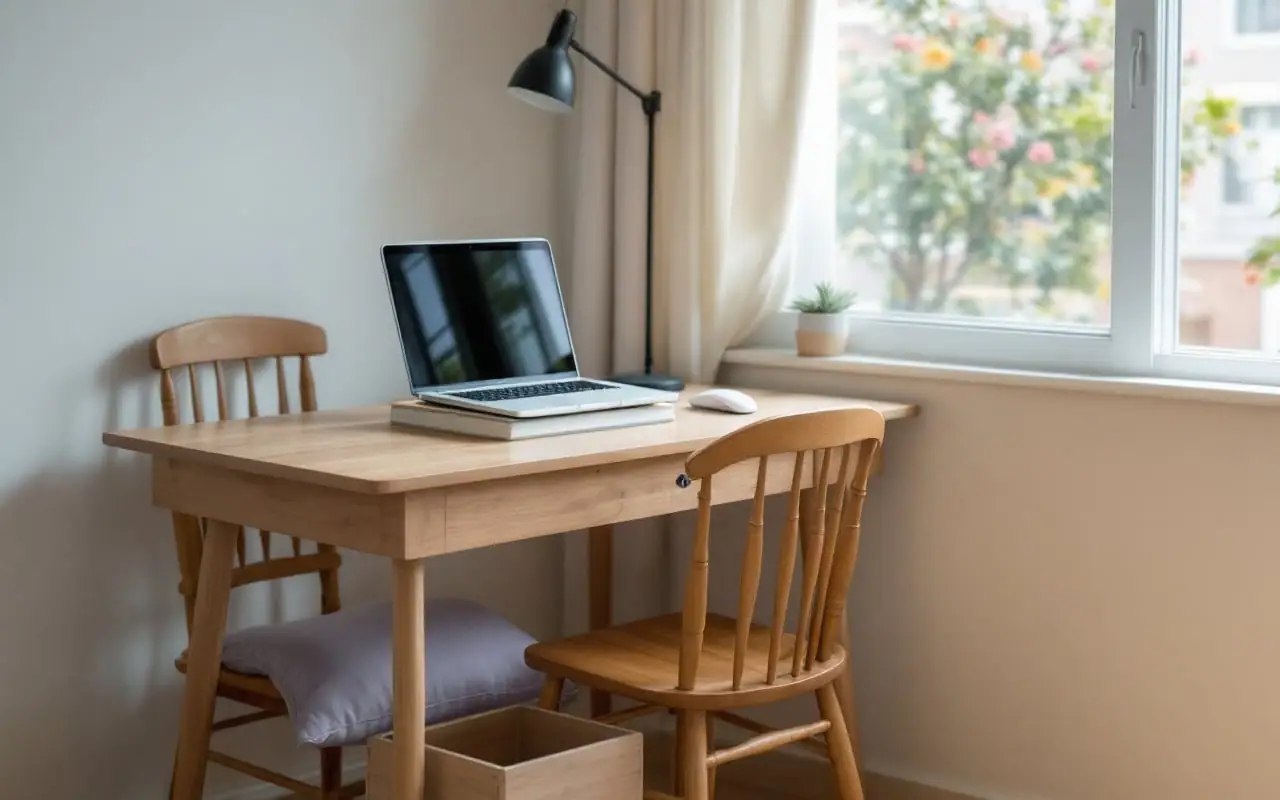
Then sort out the places where you spend long hours. I went through a home desk step by step in desk posture without the gadgets, and the short version is: screen at about eye level, keyboard close, feet supported, elbows by your sides. Books under a laptop work perfectly well at home. If you move between rooms or work in cafés, an adjustable laptop stand on Amazon does the same job and folds into a bag, though you will still want a separate keyboard.
A few other places are worth a look:
- The car. Bring the seat close enough that your knees stay slightly bent at the pedals, set the headrest level with the back of your head, and keep the backrest only slightly reclined. On long drives, a rolled towel in the small of your back suits some people.
- The sofa. Sink in by all means, just not for the whole evening. Lie on your side for a while, sit on the floor for a while, get up between programmes.
- The floor. If you sit on the floor at home, a firm cushion under your hips changes everything; there is more in the piece on sitting on the floor.
- The phone. Lift it a little nearer eye level and look up from it every few minutes.
Exercises for posture: a ten-minute routine
Do this three times a week. You need a patch of wall, a bit of floor and a resistance band (a towel will stand in for some of it). Any light band will do; a set of flat resistance bands on Amazon gives you a few strengths to work through as you improve. Move slowly and breathe normally. Mild effort and a bit of muscle ache the next day are normal. Sharp pain, or numbness or tingling down an arm or leg, means stop.
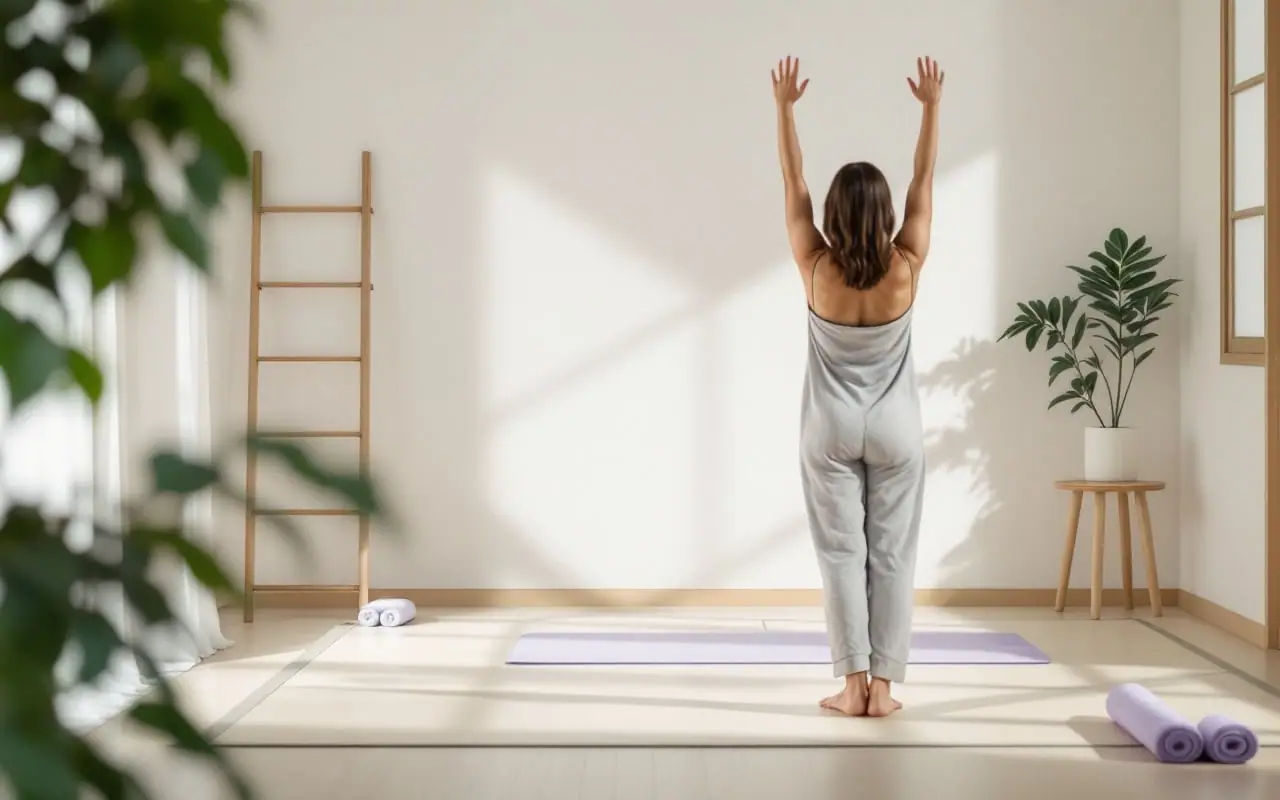
- Wall slides, 8 to 10. Stand with your back to a wall, feet a small step away from it. Raise your arms into a goalpost shape, backs of the hands towards the wall as far as is comfortable. Slide your arms up the wall and back down slowly, keeping your lower back near the wall. If your hands do not reach the wall, that is fine. It is the movement that counts.
- Band pull-aparts, 2 sets of 10 to 15. Hold the band in front of you at shoulder height, arms straight, hands about shoulder-width apart. Pull your hands out to the sides until the band touches your chest, squeezing your shoulder blades together, then return slowly.
- Band rows, 2 sets of 10 to 12. Loop the band around something solid at waist height, such as a banister or a heavy table leg. Facing it, pull your elbows back past your ribs while keeping your shoulders down, away from your ears.
- Upper-back extensions, 5 slow ones at each of two or three spots. Lie on your back, knees bent, with a rolled bath towel across your upper back just under the shoulder blades. Support your head with your hands, elbows forward, and let your upper back ease back over the towel, then curl up a little. Move the towel a hand's width and repeat. If you want something firmer that keeps its shape, there is a high-density foam roller on Amazon, about 45 cm long. Skip this one if you have osteoporosis or have been told your bones are thin, and ask a physiotherapist for an alternative.
- Glute bridges, 10 to 12. Lie on your back, knees bent, feet flat. Squeeze your buttocks and lift your hips until your body makes a straight line from shoulders to knees. Hold for two seconds and lower slowly.
- Bird dogs, 6 to 8 each side. On hands and knees, reach one arm forward and the opposite leg back, hold for a few seconds without letting your back sag or twist, and swap.
- Kneeling hip flexor stretch, 30 seconds each side. Kneel on one knee on a cushion with the other foot flat in front. Tuck your tailbone under slightly and shift your weight forward until you feel a stretch at the front of the hip on the kneeling side.
Why these? The first four work the muscles that draw the shoulders back and hold the head over the body. Bridges and bird dogs work the hips and trunk, which keep the pelvis and lower back steady. The stretch is for the front of the hips, which spend most of the day bent if you sit a lot. If your neck is the main complaint, add the chin tucks and neck stretches from the piece on katakori at the end.
None of this is exotic. The World Health Organization recommends that adults do muscle-strengthening activity on at least two days a week, on top of regular moderate activity such as brisk walking, and a routine like this counts towards that.
Four weeks, roughly
| Week | Routine | Daily habit | What to notice |
|---|---|---|---|
| 1 | Twice, one set of each | Up from the chair every hour | Which exercises feel awkward |
| 2 | Three times | Add a 10-minute walk | Whether afternoon stiffness eases |
| 3 | Three times, two sets, a firmer band | Set the desk up properly | How long you can sit before fidgeting |
| 4 | Three times, slower, pausing at the hardest point | Keep the walk, take calls standing | Whether you sit up without thinking about it |
Most people feel looser within a couple of weeks. A visible change in how you stand takes longer, often months, and some of what you see in the mirror is simply your build, which no routine will change. That is fine. The aim is a body that can hold an upright position comfortably when you want it to, not one that never slouches.
What about posture correctors?
Braces that pull your shoulders back, and sensors that buzz when you slump, do one thing well: they remind you. Some people find that handy for a week or two. The evidence that they change posture for good is thin, and a brace worn all day lets the very muscles you are trying to train take the afternoon off. A timer that tells you to get up does a similar job for nothing.
When posture is a sign of something else
Most slouching is habit. Now and then, though, a change in posture is the first visible sign of a medical problem, and these deserve a doctor's appointment:
- Height loss, or a new forward curve in the upper back, in an older adult. This can be a sign of osteoporosis with small fractures in the spine, which often happen without any fall.
- A rib hump, uneven shoulders or an uneven waist in a child or teenager, which can point to scoliosis. It shows up best when they bend forward to touch their toes.
- Back stiffness that is worst first thing, lasts more than half an hour and eases with exercise, in a younger adult. That pattern can come from inflammatory conditions such as axial spondyloarthritis.
- A new stoop that comes with a tremor, slowness or shuffling steps.
Some signs need prompt help whatever your posture. See a doctor quickly if back or neck pain comes with numbness, tingling or weakness in an arm or leg, follows a fall or other injury, wakes you at night and does not ease when you change position, or comes with a fever, weight loss you cannot explain or a history of cancer. Loss of bladder or bowel control, or numbness around the groin or buttocks, is an emergency: call an ambulance (119 in Japan, 999 in the UK) or go straight to A&E.
If your aches have not improved after a few weeks of sensible changes, a physiotherapist can watch how you move and build a programme around you. Self-referral to NHS physiotherapy is possible in many parts of the UK, and the NHS website explains the options. In Japan the usual first stop is an orthopaedic clinic.
Where to start tomorrow
Pick three things, not ten:
- Set a timer to stand up once an hour.
- Raise your screen to eye level with whatever is to hand.
- Do the routine above on Monday, Wednesday and Friday for a month, then take the side photo again.
Your posture will not be perfect at the end of it, and it does not need to be. It needs to be varied, and you need to be strong enough that sitting up straight is easy on the days you want to.

The writer
Tom worked as a sports-massage therapist in Yorkshire before moving to Kitakyushu. He writes about stiff shoulders, backs, desks and floor sitting, in plain words and without selling you a gadget.