Eucalyptus or peppermint for a stuffy nose: what each one really does
In the old Japanese calendar, winter begins around 7 November, at ritto (the start of winter). Where I live it rarely feels wintry yet, but the trains tell you the season has turned: more masks, more sniffing, and a faint smell of mint drifting from someone's scarf. That mint is usually hakka (Japanese cornmint), sprayed onto a mask from a little bottle bought at the drugstore. At home, the other bottle people reach for in cold season is eucalyptus.
Both oils have a name for "opening up" the nose, and both live in my cupboard from now until spring. They are not interchangeable, though. They act on the nose in different ways, they carry different risks, and neither does quite what the packaging hints at.
Two oils, two different tricks
Peppermint's main ingredient is menthol, usually somewhere between a third and a half of the oil. Menthol has an odd talent: it switches on the same nerve sensors in the skin and the lining of the nose that respond to cold. That is why a mint sweet makes a glass of water taste icy, and why menthol makes each breath feel cooler and faster. Your brain reads that cool rush as "more air is getting through".
Eucalyptus, in the usual blue gum type (Eucalyptus globulus), is mostly 1,8-cineole, a compound also called eucalyptol, which often makes up two thirds or more of the oil. Cineole has the sharp, camphor-like smell most of us link with a head cold, partly thanks to generations of chest rubs and throat sweets. It feels cool too, though more gently than menthol. Laboratory work suggests cineole may affect mucus and inflammation, and in some European countries it is made into capsules sold as licensed medicines for sinus and chest complaints. Those are measured, regulated products made for that route. A bottle of eucalyptus oil is neither, and it must never be swallowed: a few millilitres can seriously poison a child.
Eucalyptus radiata is a softer-smelling cousin that some people prefer, and Japanese hakka is even richer in menthol than peppermint. Treat each like its relative in everything below.
Side by side
| Eucalyptus (blue gum) | Peppermint | |
|---|---|---|
| Main compound | 1,8-cineole (eucalyptol) | Menthol, with some menthone |
| What you notice | A sharp, medicinal, clearing smell and a mild cool | A strong cold rush in the nose and on the skin |
| On the eyes | Stings | Stings more, and lingers |
| My first choice of method | A bowl of hot water, or a tissue | A tissue |
| Drops on a tissue | 1-2 | 1 |
| Drops in a bowl of hot water | 1-2 | 1, or 1 peppermint with 1 eucalyptus |
| Babies and young children | Never on or near the face; no steam bowls | Never on or near the face; no steam bowls |
| Asthma | Ask your doctor first | Ask your doctor first |
| Epilepsy | Avoid | Ask your doctor first |
| Cats | Keep diffusing well away | Keep diffusing well away |
If I could keep only one, I would choose by the situation. For a bunged-up head on a weekend evening, eucalyptus in a bowl of hot water. On the train or at a desk, one drop of peppermint on a tissue. The two also blend well; half and half they smell like a good cough sweet, and the essential oil dictionary has fuller entries on both.
Does either one actually unblock your nose?
The honest answer is that both make a blocked nose feel clearer more than they make it measurably clearer.
The best-known work is on menthol. In small laboratory studies, people with colds who breathed in menthol said their nose felt more open, while the instruments measuring how much air actually flowed through it showed no real change. The sensation was genuine, but it came from the cold sensors, not from more space in the nose. Cineole has less human research on breathing it in, and most of what exists is small.
It helps to know what the stuffiness of a cold actually is. Most of it comes from swollen blood vessels in the lining of the nose, not from mucus alone, and no scent shrinks those for long. Steam on its own has been studied too, and reviews of breathing warm, moist air for colds have not found a clear, lasting benefit. Any relief tends to fade within the hour.
None of that makes the oils pointless. If a drop on a tissue makes you feel you can breathe and lets you settle to sleep, that comfort is real. Just treat it as comfort rather than treatment. For something stronger, a pharmacist can suggest a saline spray or rinse, or a decongestant nasal spray. Decongestant sprays are meant for a few days only, because longer use can make the stuffiness worse once you stop.
The tissue: where I always start
A tissue costs nothing, uses a single drop, and you can throw it away if the smell is too much.
- Put 1 drop of peppermint, or 1 to 2 drops of eucalyptus, on a folded tissue.
- Hold it a few centimetres below your nose and breathe normally for a minute or two. Deep breath after deep breath just makes your eyes water.
- Keep the oily patch off your skin. Neat oil under the nose stings and can leave a red, sore strip, which is the last thing a cold-raw nose needs. Never put oil inside the nostrils.
- At night, leave the tissue on the bedside table rather than the pillow, so it cannot end up under your cheek or near your eyes.
- If you scent a mask, put one drop on the outside near the lower edge and let it dry for a few minutes first. Never scent a mask a child will wear.
- Throw tissues away where small hands and pets cannot get at them.
A diffuser is fine for an adult's room: 3 to 4 drops, run for 30 to 60 minutes, then off with the window open. Leave it out of children's bedrooms and away from cats.
Steam, done carefully
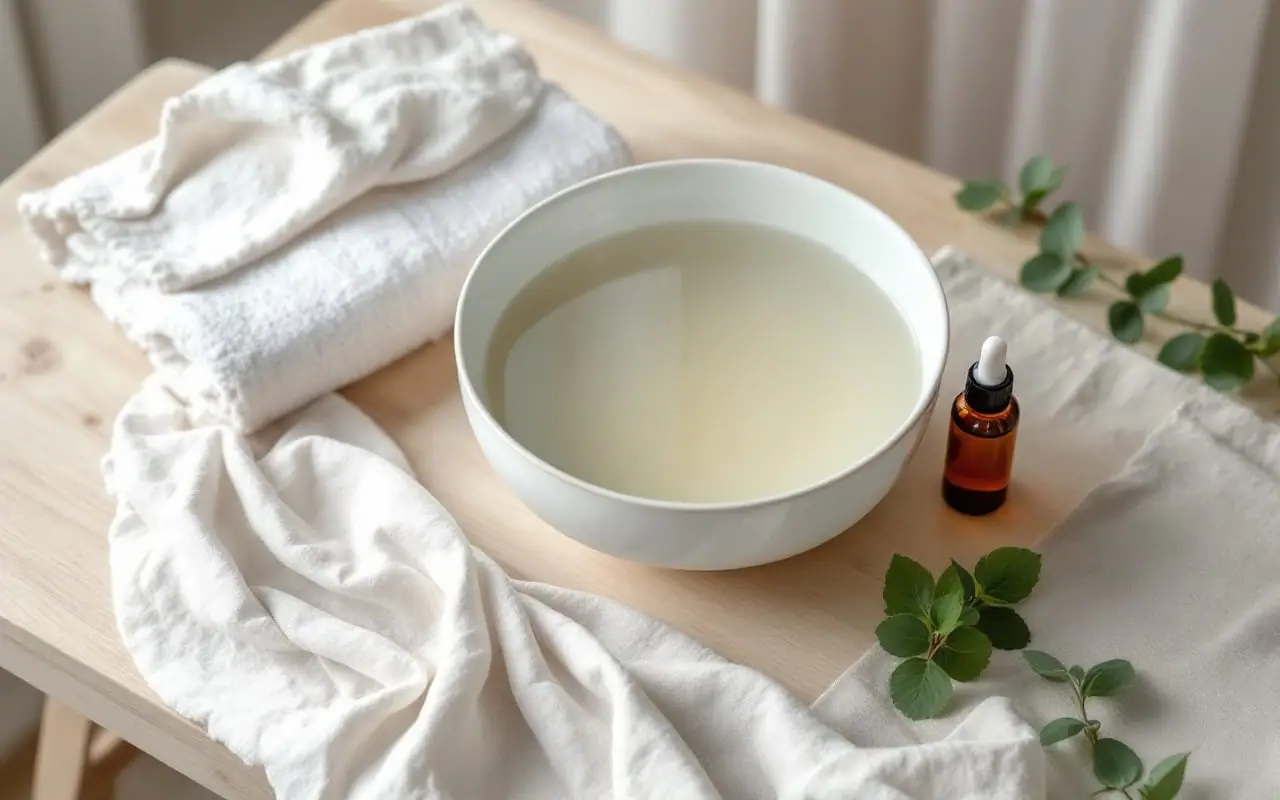
Steam bowls cause scalds every winter. Bowls tip, people jolt when they sneeze, and boiling water burns faster than you can pull away. If you use one, set it up like this.
- Let the kettle stand for a few minutes after it boils, or top up with a little cold water, so the water is steaming hard but not bubbling.
- Put the bowl on a steady table and sit down to it. Never on your lap, never in bed.
- Add 1 to 2 drops of eucalyptus, or 1 drop of peppermint, or one of each. More only makes your eyes stream.
- Close your eyes and lean in only as far as feels warm, not hot. A towel over your head traps more steam; if you use one, leave a gap so you are not breathing a cloud of concentrated vapour.
- Breathe normally for a few minutes, five at most, then sit back. Two or three short sessions a day is plenty.
- Pour the water away as soon as you finish, before a child or a pet finds it.
Steam bowls are not for children. The scald risk is too high, and their faces are exactly where these oils should not go. For a child with a cold, the steam of a warm bathroom with the shower running, plenty of fluids and saline drops are the usual suggestions, and a pharmacist can advise on anything more.
Who should leave both bottles closed
- Babies and young children. Menthol or cineole close to a small child's face can trigger breath-holding or a spasm of the voice box, which is why menthol chest rubs carry an age limit on the label. Keep both oils off their chests, pillows and cot sheets and out of their rooms. Cautious writers extend this rule well into primary school age. My guide to essential oils around children and pets has the full list and what to do if a bottle is swallowed.
- People with asthma. Strong scents and steam can both set off coughing or wheezing. Ask your doctor before trying either, and never use an oil in place of an inhaler. If you get the go-ahead, a tissue held further away is gentler than a bowl.
- People with epilepsy. Avoid eucalyptus, and ask about peppermint.
- Pregnancy. Ask your midwife or doctor first, and keep to the tissue method if you are cleared to use oils at all.
- Anyone the smell gives a headache to, or who simply dislikes it. A scent you hate will not make you feel better.
- Cats, birds and other small pets. Diffuse in rooms they can leave, or not at all.
When a cold is more than a cold
Most colds ease within a week or two, although a cough can hang on for a few weeks after the rest has gone. A bottle of oil is no reason to wait it out if things are going the wrong way. See a doctor if:
- you have a high temperature or feel hot and shivery, especially if it lasts more than a few days, or comes back after you had started to feel better;
- your symptoms are getting worse after a week rather than better, or are still going after about three weeks;
- you have pain and pressure around the cheeks or forehead with thick, coloured discharge for more than about ten days, which may be sinusitis;
- you are older, pregnant, or live with heart, lung or kidney disease, diabetes or a weakened immune system and you feel flu-like. Flu medicines work best when started within about two days, so do not wait to see whether it passes.
Get help the same day, or call 119 in Japan, for breathlessness, chest pain, wheezing, coughing up blood, swelling or redness around one eye, double vision, a severe headache with a stiff neck, or confusion. For babies and children, any fever in a baby under 3 months, or a child who is unusually drowsy, floppy, breathing fast or refusing drinks, needs a doctor promptly; in Japan, #8000 connects you to a children's advice line out of hours, and many prefectures run #7119 for adults. The NHS has clear advice on looking after a cold at home.
The one thing to keep in mind from now until spring: the scent is the comfort and the bowl is the hazard. Keep the drops low, the water off the boil, and both bottles well away from small faces.

The writer
Philippa is a British writer who has lived in Japan for many years and has blended essential oils at home for two decades. She looks after the Aroma corner and never writes a recipe without the dilution.