Frankincense essential oil: scent, uses, safety and buying
Frankincense essential oil is distilled from the dried resin of small, tough Boswellia trees that grow on dry, rocky hillsides in the Horn of Africa, southern Arabia and India. Its scent opens with lemon peel and black pepper and settles into a soft, warm incense, lighter and cleaner than the smoke from a church censer. In Japan you will see it sold under its English name or as nyuko ("milk incense", after the milky look of the fresh resin). If I could keep only five oils, it would be one of them. It is also one of the most over-promised oils on the internet, so this page tries to keep the pleasure and the claims apart.
A note: links to Amazon here are affiliate links. As an Amazon Associate I earn from qualifying purchases.
If you only get one
Frankincense essential oil
Boswellia carterii, soft and resinous; it blends with almost anything.
View on AmazonOr, if it suits you better: cold-pressed jojoba oil or amber roller bottles, 10 ml, both on Amazon.
At a glance
| Fact | Frankincense |
|---|---|
| Botanical names | Boswellia carterii and B. sacra most often; also B. frereana, B. papyrifera, B. serrata |
| Plant family | Burseraceae, the same family as myrrh |
| Part used | Gum resin, collected from cuts in the bark |
| Extraction | Steam or water distillation; CO2 extracts also exist |
| Main origins | Somalia and Somaliland, Oman, Yemen, Ethiopia, India |
| Scent | Fresh, peppery and lemony over warm resin |
| Phototoxic | No |
| Keeps once opened | About 1 to 2 years; it oxidises |
What it is and where it comes from
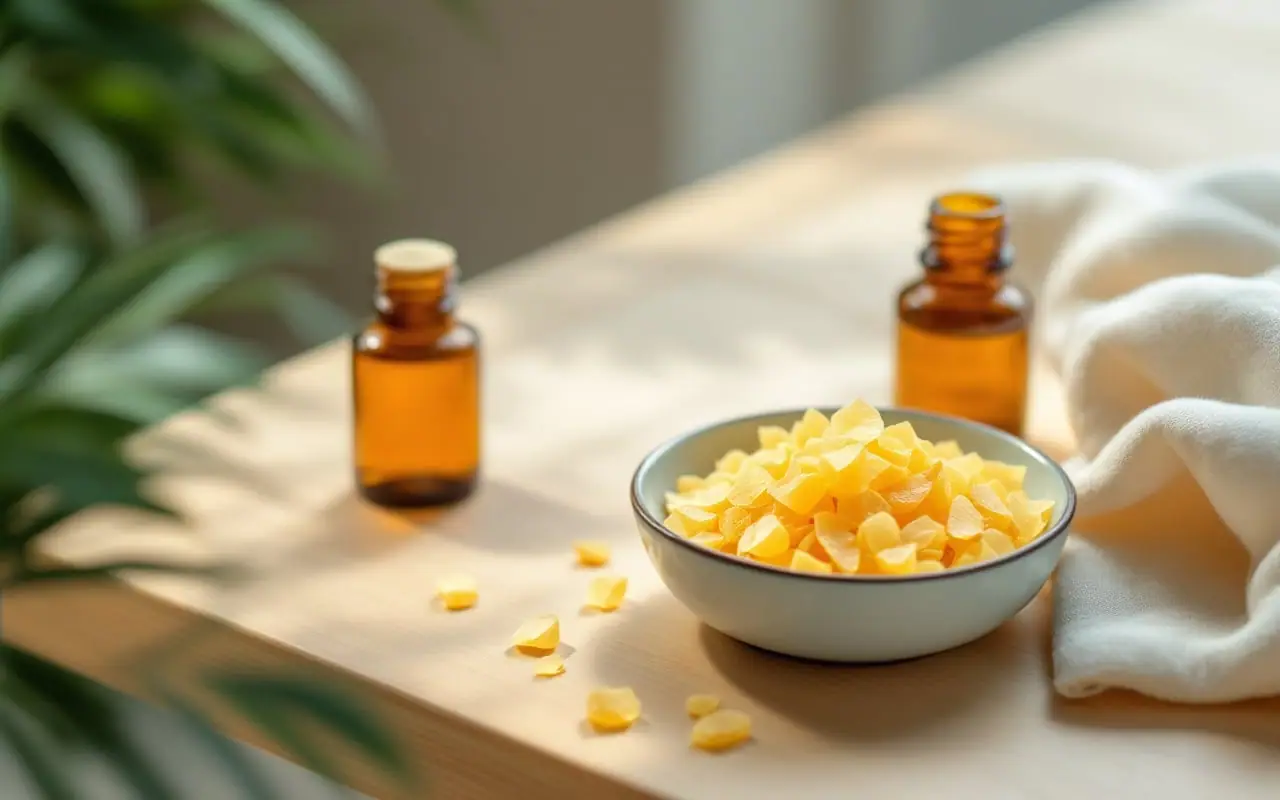
Harvesters make shallow cuts in the bark, and a pale, sticky resin seeps out and hardens in the air into "tears". These are collected by hand some weeks later, sorted by colour and size, and sold either to be burned as incense (often under the old name olibanum) or to be distilled. The resin has been traded for thousands of years along the incense routes out of southern Arabia, burned in temples and churches, and it is one of the three gifts in the Christmas story. Japan's own incense tradition, kodo (the "way of incense"), is built mainly on agarwood and sandalwood rather than frankincense, so to many Japanese noses it reads as a European, church-like scent.
"Frankincense" covers several species, and they are not interchangeable. Boswellia carterii (from Somalia) and B. sacra (from Oman and Yemen) are so close that many botanists treat them as one species. Their oils are made up mostly of monoterpenes, especially alpha-pinene, with limonene and others, which gives the fresh, lemony lift. B. papyrifera from Ethiopia and Eritrea gives a softer, fruitier oil dominated by a different compound, octyl acetate. B. frereana and the Indian B. serrata smell different again. When a label names a chemotype, such as an "alpha-pinene type", it is telling you which chemical profile to expect.
One fact worth holding on to: the boswellic acids that are studied in frankincense supplements are large, heavy molecules that stay behind in the still. They are in the resin and in tablet extracts, but not in the distilled oil.
What does frankincense oil smell like?
Open a fresh bottle and the first thing you notice is citrus peel and a dry, peppery sparkle, almost like pine needles crushed in your hand. After a few minutes on a blotter strip that fades into a soft, resinous heart, a little woody and faintly sweet, which lingers for some hours. Perfumers class it as a middle to base note. It is lighter and less sticky-sweet than myrrh or benzoin, and many people describe it simply as "clean" or "quiet". Oils from different species and regions smell noticeably different, which is part of the fun and part of the confusion.
How people use it at home
| Method | Amount | Notes |
|---|---|---|
| Tissue | 1 drop | Hold a little below the nose for a few minutes of slow breathing |
| Ultrasonic diffuser | 3-4 drops per 100 ml of water | Run 30 to 60 minutes, then switch off and air the room |
| Face oil | 0.5-1% (1-2 drops in 10 ml) | A light carrier such as jojoba; keep well away from the eyes |
| Body or massage oil | 1-2% (2-4 drops in 10 ml) | For regular use |
| Small area, a few days | up to 3% (up to 6 drops in 10 ml) | Not the whole body, not for weeks |
| Bath | 3-5 drops | Mixed first into a tablespoon of unscented liquid soap or bath base |
| Roller bottle | 2 drops in 10 ml (1%) | Wrists, the back of the neck |
In a diffuser it pairs well with sweet orange: two drops of each in a 100 ml tank gives a warm, friendly winter blend. The guide to choosing a diffuser covers tank sizes and drops in more detail.
On skin, frankincense is not one of the oils that comes with its own low ceiling, so your ordinary strength for the purpose applies. The dilution calculator works out the drops for any bottle size and splits them between oils if you blend.
Face oils with frankincense are popular, often sold with talk of "anti-ageing". There is no good evidence in people that the oil reduces wrinkles or fades marks. What a face oil does for dry skin mostly comes from the carrier. Frankincense adds a lovely scent, and that is a perfectly good reason to use it at 0.5 to 1 percent.
What does the research say?
Most of the confident claims you will read online rest on one of three kinds of research, and none of them shows that rubbing or breathing frankincense oil treats an illness.
The first is research on Boswellia resin extracts taken as tablets, mostly from B. serrata, for joint pain. Small trials have suggested a modest benefit for osteoarthritis, but those extracts are standardised for boswellic acids, which the oil does not contain. Results from the tablets cannot be borrowed for the bottle. Supplements are also a different matter with their own side effects and possible interactions, so talk to a pharmacist before taking one.
The second is laboratory work on cells, including cancer cells, and on animals. These studies interest scientists and occasionally make headlines, but a result in a dish is a long way from a treatment. There is no good evidence that frankincense oil treats cancer, and nobody should delay or replace medical treatment because of it.
The third is aromatherapy research in which frankincense was one oil in a blend, often given with massage to small groups of people, for example in palliative care, and measuring mood, anxiety or comfort. Some of these studies report people feeling calmer, but with small numbers, mixed oils and the effect of touch and attention, it is hard to say what the frankincense itself did.
So the honest summary: frankincense oil is a pleasant, calming scent for many people, and a good-natured oil on skin when fresh and diluted. Enjoy it as that. If you are living with cancer, arthritis or any long-term illness and would like to use oils for comfort, tell your doctor or care team, who can advise around your treatment.
Safety
- Never swallow it. You may come across advice online to put drops under the tongue, in water or in capsules. Do not. Swallowed essential oils can burn the mouth and throat and poison children in small amounts.
- Use it fresh. Because it is rich in monoterpenes, frankincense oxidises once opened, and oxidised oil is more likely to irritate skin and cause an allergy. Keep the cap tight, store it cool and dark, and finish it within about one to two years. How long essential oils last explains the signs of ageing.
- Patch test any new blend on the inside of your forearm and check after 24 to 48 hours.
- It is not phototoxic, so it is fine in a daytime face blend.
- Pregnancy and breastfeeding: frankincense is not among the oils that safety references usually say to avoid in pregnancy, but keep to 1 percent or less, talk to your midwife or doctor first, and take extra care in the first three months. When breastfeeding, keep blends off the breast.
- Babies and children: no essential oils on babies under 3 months. For children aged 2 to 6, 0.5 to 1 percent on skin is the usual ceiling, and diffusing should be brief, with the child out of the room or able to leave it, and never overnight.
- Cats and other pets: frankincense shares its main components with pine and citrus oils, which are on lists of oils of concern for cats. My rule is never on a cat or a dog, diffusing only briefly with a door open so animals can leave, and no diffusing at all near birds or small caged pets. In the US the ASPCA runs an animal poison control line.
- Asthma and epilepsy: strong scents can set off asthma, so ask your doctor before diffusing. Burning the resin as incense indoors adds smoke to the air, which is a separate concern for anyone with asthma.
Stop using a blend that stings or reddens your skin. See a pharmacist or doctor if a rash spreads, blisters, is on your face or has not settled within a few days. If a child swallows frankincense or any essential oil, phone a doctor or poison advice line straight away and do not make them vomit. Swelling of the lips or face, wheezing or trouble breathing needs urgent help: call 119 in Japan, or your local emergency number.
How to choose a bottle
- The botanical name should be on the label. "Frankincense" on its own is not enough, and a good seller will tell you which Boswellia species is in the bottle.
- Look for a country of origin, ideally a region, and a batch number, plus a distillation or best-before date if you can get one.
- Check the part and method: resin, steam-distilled. A CO2 extract is a different, thicker product and should say so.
- Dark glass, a dropper insert and a sealed cap.
- Price sanity: frankincense usually costs more than lavender or sweet orange and much less than rose or true sandalwood. A bottle priced like the most common oils, with a vague label, deserves a question.
- Adulteration is common. Frankincense can be stretched with carrier oil, which leaves a greasy ring when a drop dries on paper, or with pine-type compounds from other sources, which only a laboratory test can detect. A supplier who can share a GC-MS report (a chemical breakdown) for your batch is a good sign.
- "Therapeutic grade" and similar phrases are marketing terms, not standards.
- Ask about sourcing. Wild trees that are tapped too often or too young produce less resin and can die, and researchers have warned that some wild frankincense populations are declining. Sellers who name the region and explain how the resin is harvested are easier to trust.
If you want to try it, start with a 5 or 10 ml bottle labelled Boswellia carterii or B. sacra, with an origin and a batch number. One example is a small bottle of frankincense essential oil on Amazon.
Pairs well with
- Sweet orange: bright and friendly, a good winter diffuser blend.
- True lavender: soft and settling for the evening.
- Myrrh: deeper and darker, the classic church pairing.
- Black pepper: warm and spicy, about three parts frankincense to one of pepper.
- Sandalwood or Atlas cedarwood: creamy or woody, and long-lasting.
- Bergapten-free bergamot: a citrus lift that is safe for daytime skin blends.
- Hinoki (Japanese cypress): a forest-and-temple feel.
The page on which oils blend well explains why resins sit so easily with citrus, spice and wood.
For a first blend on skin, fill a 10 ml roller bottle with jojoba and add 1 drop of frankincense and 1 drop of true lavender. That is a 1 percent blend, gentle enough for wrists and the back of the neck. Label it with the oils and the date, and use it within a few months.

The writer
Philippa is a British writer who has lived in Japan for many years and has blended essential oils at home for two decades. She looks after the Aroma corner and never writes a recipe without the dilution.