How to choose an essential oil diffuser: types, drops and safety
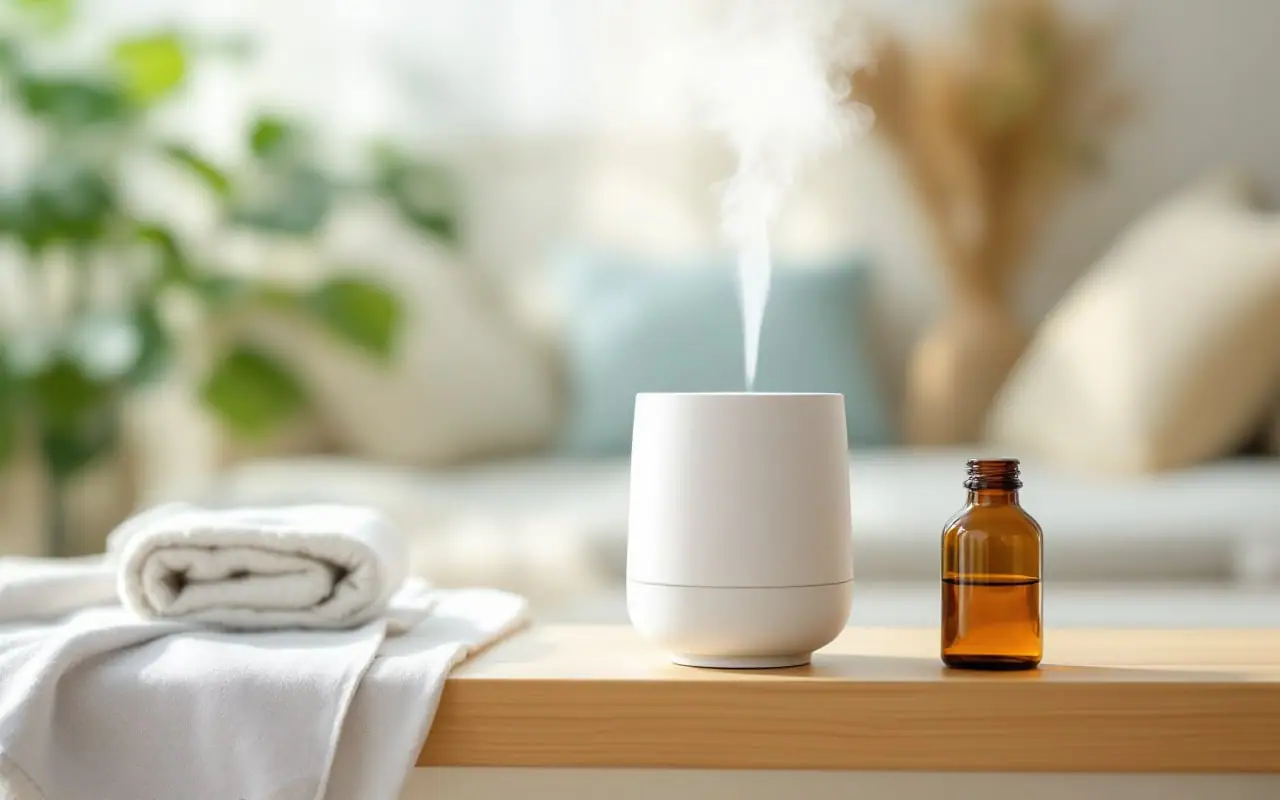
An essential oil diffuser is how most people start using oils at home, and it is also where most of us overdo it. This guide is for anyone buying a first diffuser, or replacing one that has started to gurgle and leave a white film on the shelf. The choice is simpler than the shop displays suggest. Four things decide it: the size of the room, whether the machine switches itself off, how easy it is to keep clean, and who else breathes the air (a baby, a cat, someone with asthma). Looks come last, although I understand why they rarely do.
What matters in an essential oil diffuser
Room size and tank size
Tank size tells you how long a diffuser can run and how much water carries the oil. It does not tell you how strong the scent will be. A tank of 100 to 150 ml is enough for a bedroom, a study or a six-mat room (about 10 square metres). A 300 to 500 ml tank suits a living room or an open-plan space, or a smaller room where you want several short sessions in an evening without refilling. A bigger tank also needs more drops for the same strength, which is easy to forget.
Makers print run times on the box, usually for continuous mist. Treat those as a measure of capacity, not a goal. Nobody needs a diffuser running for eight hours straight.
An automatic shut-off and a timer
Look for two things on the specification sheet. The first is a shut-off that stops the machine when the water runs low, so it never runs dry. The second is a timer, ideally with a 30 or 60 minute setting, or an intermittent mode that mists for a short spell and then pauses. Both support the habit that matters most for comfort and safety: diffuse for 30 to 60 minutes, then switch off for at least as long. A diffuser without a timer relies on you remembering, and after a long day I do not, reliably.
Water or no water
Ultrasonic diffusers mix a few drops of oil into water and turn it into a cool mist that is almost all water. Nebulising diffusers, usually sold as waterless diffusers, use the oil neat. They give a stronger scent in the same few minutes, add no moisture to the air and get through oil much faster. For a gentle background scent, choose water. For a large room scented in short bursts, by someone happy to use more oil, a waterless model makes sense.
Noise and light
In a bedroom, sound matters more than any other feature. Ultrasonic diffusers are close to silent, with a faint ticking or bubbling as the water moves. Nebulisers have a small air pump with a steady hum. Many diffusers come with coloured lights, which are fine in a living room and distracting at night, so check for a setting that turns the light off while the mist stays on.
Cleaning and materials
Every diffuser needs regular cleaning, so check that the tank opening is wide enough to wipe with a cloth or cotton bud. Most ultrasonic tanks are plastic. Some makers warn that citrus oils can mark or weaken plastic over time, so read the manual before you put sweet orange or lemon into a new one, and rinse the tank after citrus blends. Nebulisers usually have a glass reservoir that is easy to clean but breakable. A ceramic or wood-look cover is a shell around a plastic tank, so judge the inside as well as the outside.
Who shares the room
This matters more than anything printed on the box. In a home with a young baby, a cat, a bird, small caged pets or anyone with asthma, the right diffuser is a small one used briefly, on the lightest setting, in a room that people and animals can leave. Some households are better off without an active diffuser at all. Check the oils as well as the machine: the essential oil safety chart shows which ones to leave out with pregnancy, young children, epilepsy, cats and dogs.
The main kinds of diffuser
Here is what each type is and who it suits. None of them is the right answer for everyone.
A note: links to Amazon here are affiliate links. As an Amazon Associate I earn from qualifying purchases.
How many drops in a diffuser?
For an ultrasonic diffuser, makers' instructions usually say 3 to 5 drops of essential oil per 100 ml of water. That is the total, all oils together. I start at the low end with any new oil, because a scent that seems faint when you walk in can feel heavy half an hour later, and noses tire quickly.
For a medium-sized room:
| Water in the tank | Light | Standard | Strong |
|---|---|---|---|
| 100 ml | 3 drops | 4 drops | 5 drops |
| 200 ml | 6 drops | 8 drops | 10 drops |
| 300 ml | 9 drops | 12 drops | 15 drops |
| 400 to 500 ml | 12 to 15 drops | 15 drops | 15 drops |
In a small room (up to about 10 square metres) use about a quarter fewer drops, and in a large room (over about 25 square metres) about a quarter more. Whatever the tank, I stop at 15 drops. In a home with a baby, a pet or someone with asthma, use the light column and no more than 6 drops. The diffuser drops calculator does this arithmetic for your tank and room and splits the total between two or three oils.
Fill the tank with water to the line first, then add the oil, so the drops land on water rather than straight onto the plastic.
Nebulising diffusers do not work in drops. They run on neat oil from the bottle or the reservoir, so you control strength with the timer and the output setting. Start with the shortest burst and the lowest output, and give the room a while to settle before deciding it needs more.
The test for the right amount is simple. You should notice the scent as you come into the room, then stop noticing it within a few minutes. If the next room smells strongly, or you have a dull headache, it is too much.
Two oils to start with
True lavender (Lavandula angustifolia) and sweet orange are gentle, easy to find and pleasant together. Two drops of each in a 100 ml tank makes a soft evening blend. Sweet orange oxidises quickly once opened, so buy a small bottle and finish it within about a year. In a home with cats, leave the orange out: citrus oils are among the oils of concern for cats. Lavender needs care too, so diffuse it briefly, with the door open.
Leave peppermint, eucalyptus and rosemary out of rooms where babies and young children sleep or play. Their main components can affect a small child's breathing.
Day-to-day habits that keep it safe
- Put the diffuser on a flat, stable surface, out of reach of children and pets, with the cord tucked away so nobody can pull it down. A tray or mat underneath protects wooden furniture from drips and from the fine oily film that mist leaves behind.
- Run it for 30 to 60 minutes, then switch off for at least as long. Keep a door or window open.
- Never run it overnight in a small closed bedroom, and never in a room where a baby is asleep. For babies under 3 months, I would not diffuse in any room they use.
- Empty the tank after each session, rinse it and leave it to dry. Standing water grows mould and bacteria, which you would then breathe in with the mist. Give it a proper clean once a week, following the manual (many suggest a little white vinegar or rubbing alcohol on a cotton bud).
- Use tap water unless the manual says otherwise. Hard water leaves a white mineral dust around the room. Most tap water in Japan is soft, so this is less of a nuisance here than in hard-water areas such as much of south-east England.
- Do not add essential oils to an ordinary humidifier unless its manual says you can.
When to switch off, and when to get help
Switch off and open a window if anyone gets a headache, feels sick, starts coughing or sneezing, or has stinging eyes. In cats and dogs, watch for drooling, pawing at the face, wobbly walking or fast breathing, and call a vet if the signs do not settle quickly once the room is aired.
If you have asthma or another lung condition, ask your doctor before you diffuse at all, because strong scents can set off symptoms. Wheezing, a tight chest, or swelling of the lips or face after using any oil needs urgent help: call 119 in Japan, or your local emergency number. If a child drinks from a diffuser tank or gets hold of a bottle, phone a doctor or poison advice line straight away, even if they seem well, and do not try to make them vomit. The steps are set out in full in essential oils around children and pets.
One more thing. If the diffuser has become your nightly answer to weeks of poor sleep, low mood or headaches, that pattern deserves a conversation with your doctor. A pleasant scent can make an evening nicer; it cannot find out what is wrong.
Before you buy: a short checklist
- A tank that matches the room: 100 to 150 ml for a bedroom, 300 to 500 ml for a living room.
- An automatic shut-off when the water runs low.
- A timer or intermittent mode, with a 30 or 60 minute setting.
- A light you can switch off, if it will live in a bedroom.
- A tank you can reach into and wipe clean.
- A spot for it that is stable, out of reach and away from where pets eat and sleep.
How the products on this page were chosen
The diffusers and oils linked here were picked from their specifications (tank size, shut-off, timer settings, materials), the makers' own information and other published information. I have not used these particular models, and nothing on this page comes from hands-on trials. Listings change, so check the current details, especially the shut-off and the timer, before you buy.

The writer
Ruth is a British writer who has lived in Japan for many years and has blended essential oils at home for two decades. She looks after the Aroma corner and never writes a recipe without the dilution.