Diluting essential oils for skin: a practical chart
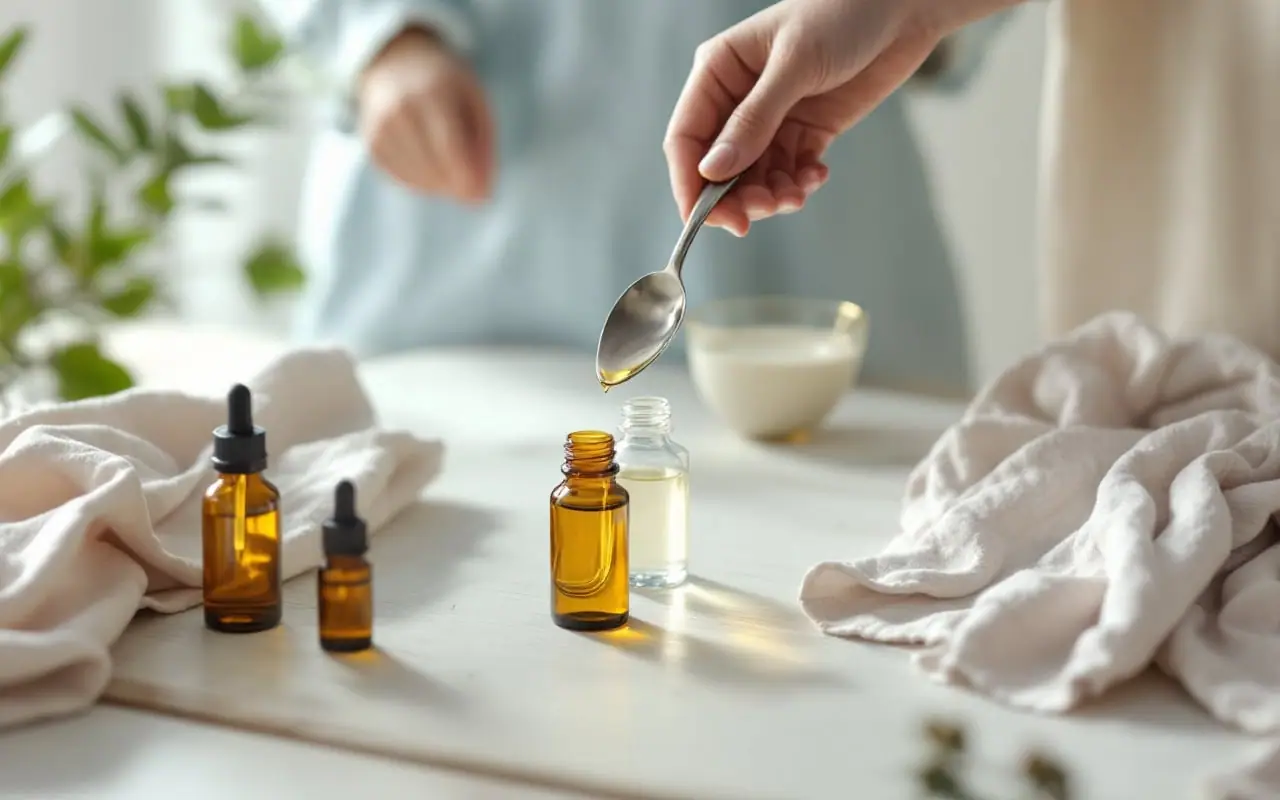
After "which oil should I buy", the question I hear most is "how many drops?". Bottle labels rarely say, and recipes online are often far stronger than they look. A recipe that calls for 10 drops in a tablespoon of carrier oil works out at more than 3 percent, which is more than I would put on a whole body.
So here is the chart I keep taped inside my oil cupboard, with the reasoning behind it.
How the numbers work
A dilution percentage is the share of the finished blend that is essential oil. To turn that into drops, aromatherapy uses a simple convention: 20 drops make 1 ml. One percent of 10 ml is 0.1 ml, which is 2 drops. Everything in the chart follows from that.
Real drops are not that tidy. Their size changes with how thick the oil is, how warm the room is, the plastic dropper insert in the neck of the bottle and how far you tilt it. Thick oils such as vetiver may barely drip at all. The chart is close enough for home use, but it is an estimate, which is one more reason to work in the middle of the ranges rather than at the top.
For measuring carrier oil, a kitchen spoon set is all you need. The Japanese kosaji is 5 ml and the osaji is 15 ml, the same as a metric teaspoon and tablespoon in Britain, so 10 ml is two teaspoons and 30 ml is two tablespoons.
The chart
Total essential oil drops, all oils together:
| Dilution | 10 ml (2 teaspoons) | 30 ml (2 tablespoons) | 50 ml |
|---|---|---|---|
| 0.25% | half a drop: make 20 ml with 1 drop instead | 1.5 (use 1) | 2.5 (use 2) |
| 0.5% | 1 | 3 | 5 |
| 1% | 2 | 6 | 10 |
| 1.5% | 3 | 9 | 15 |
| 2% | 4 | 12 | 20 |
| 2.5% | 5 | 15 | 25 |
| 3% | 6 | 18 | 30 |
| 5% | 10 | 30 | 50 |
When a number falls between drops, round down. The 5 percent row is there so you can recognise how strong a recipe is, not as a target. At home I only go that high for a single small spot, used briefly.
Which strength for which skin
| Who or where | Dilution | Drops in 10 ml | Notes |
|---|---|---|---|
| Adult face | 0.5-1% | 1-2 | Thinner skin, close to the eyes. Leave cold-pressed citrus oils out of daytime face blends |
| Adult body, used most days | 1-2% | 2-4 | Body oils, massage blends, after-bath oil |
| Adult, small area, short term | up to 3% | up to 6 | A stiff neck or tired calves for a few days, not the whole body and not for weeks |
| Sensitive or eczema-prone skin | 0.5-1% | 1-2 | Gentle oils only. Never on broken, weeping or inflamed skin |
| Older people | up to 1% | up to 2 | Thinner skin, often more medicines, and a duller sense of smell that can lead to heavy hands |
| Pregnancy | up to 1% | up to 2 | Talk to a midwife first, especially in the first three months |
| Babies under 3 months | none | 0 | Plain carrier oil only, if anything |
| 3 to 24 months | 0.25% at most | 1 drop in 20 ml | Most families are better off with plain oil |
| 2 to 6 years | 0.5-1% | 1-2 | Gentle oils, kept away from the face |
| 6 to 12 years | 1%, up to 1.5% on a small area | 2-3 | Short courses rather than daily for months |
| Teenagers | adult body levels, starting at 1% | 2-4 | Watch for reactions on acne-prone skin |
In pregnancy, most safety writers advise avoiding some oils altogether, including aniseed, fennel, sage, hyssop, camphor, parsley seed, wintergreen, birch and Spanish lavender (Lavandula stoechas). When breastfeeding, keep blends off the breast and nipple so the baby does not take them in.
For older relatives, the lower strength is not only about skin. Many people take several medicines by their seventies, and anyone on blood thinners should check with a pharmacist before using oils high in methyl salicylate (wintergreen, birch) or eugenol (clove).
For children, gentle oils means things like true lavender, mandarin or Roman chamomile, used for short spells. Peppermint and eucalyptus should stay well away from the faces of babies and young children.
Mixing a blend, step by step
- Choose the strength from the table above. If you are unsure between two rows, take the lower one.
- Measure the carrier oil into a clean, dry glass bottle. Sweet almond, jojoba, sunflower and rice bran oil (easy to find in any Japanese supermarket) all work; skip sweet almond if anyone using it has a nut allergy. For very dry skin, avocado oil mixed in at 10 to 20 percent of the carrier adds richness.
- Read off the total drops from the chart. If you are using more than one oil, split that total between them. The guide to blending factors explains how to share drops so a strong oil does not swamp a gentle one, and the page on which oils blend well helps with choosing partners. Then check whether any of your oils has its own ceiling (see the next section).
- Add the drops slowly with the bottle held upright, counting aloud. If you lose count, assume the higher number and add carrier to match: if 4 drops in 10 ml might have become 6, move the blend to a bigger bottle and top it up to 15 ml.
- Cap the bottle, roll it gently between your palms and label it with the oils, the percentage and the date.
- Patch test before the first full use.
Store blends cool and dark and use them within a few months. If a blend starts to smell like old crayons or putty, the carrier has gone rancid and it belongs in the bin. Freshness matters for the essential oils too: lavender, for one, is gentle on skin only while it is fresh, as I explain in what the research shows about lavender.
Oils that come with their own ceiling
Some oils contain components that irritate or sensitise skin at low levels, mainly aldehydes such as cinnamaldehyde and citral, and phenols such as eugenol. Others are phototoxic: on skin that then meets sunlight, they can cause burn-like patches and dark marks that last for months. For these oils, safety references give a maximum skin level that sits below your general strength.
The figures below are the maximum skin levels suggested by Robert Tisserand and Rodney Young in their reference book Essential Oil Safety. The citrus figures match the limits the fragrance industry uses for leave-on products.
| Oil | Why it is limited | Suggested maximum on skin | In practice |
|---|---|---|---|
| Cinnamon bark | cinnamaldehyde, a strong sensitiser | 0.07% | Less than one drop in 50 ml. Keep it for the diffuser, not your skin |
| Clove bud | eugenol, irritates and sensitises | 0.5% | 1 drop in 10 ml, 5 in 50 ml |
| Lemongrass | citral, a sensitiser | 0.7% | 1 drop in 10 ml, 4 in 30 ml |
| Bergamot, cold-pressed | phototoxic | 0.4% | Less than one drop in 10 ml, 4 in 50 ml |
| Lime, cold-pressed | phototoxic | 0.7% | 1 drop in 10 ml |
| Lemon, cold-pressed | phototoxic | 2% | 4 drops in 10 ml |
| Grapefruit, cold-pressed | phototoxic | 4% | 8 drops in 10 ml, but your general strength will be lower |
Two rules make the table work. First, your general strength sets the total and the ceiling sets that oil's share. Say you want a 30 ml body oil at 2 percent: that is 12 drops in total. Lemongrass is capped at 0.7 percent, which is 4 drops in 30 ml, so you could use 4 drops of lemongrass and 8 of lavender. Second, if a ceiling is higher than the strength you chose from the table, the table wins.
The citrus limits only matter for leave-on products on skin that will see sunlight or a sunbed within 12 hours. Steam-distilled lemon and lime, and bergamot sold as bergapten-free (often marked FCF), are not phototoxic. Sweet orange and mandarin are low risk.
Baths need a go-between
Essential oils do not dissolve in water. Drip them straight into the bath and they float as undiluted droplets, which then meet the most sensitive skin you have as you sit down. The usual result is stinging and redness.
Mix 3 to 5 drops of a gentle oil into about a tablespoon of unscented liquid soap, shower gel or a bath base made for the job, then add it to the filled bath and swish. Bath salts look as if they should help, but salt does not dissolve oil. Plain carrier oil dilutes the droplets a little, but it still floats and makes the tub slippery. Keep cinnamon, clove, lemongrass, peppermint, oregano, thyme and citrus peel oils out of the bath entirely. For a hand or foot bath, 1 to 2 drops in a teaspoon of dispersant is plenty.
In a Japanese home the ofuro (deep bath) water is usually shared, with everyone washing first and then soaking in turn. If children use the same water, either leave the oils out or add them for the last adult. If your bath reheats and recirculates the water, check the manual before adding anything oily. For children under about six, I leave essential oils out of the bath altogether.
How to patch test
- Mix a small amount at exactly the strength you plan to use.
- Rub a little onto the inside of your forearm, over an area about the size of a 500 yen coin.
- Cover it with a plaster if you like, and leave it unwashed for 24 hours, or up to 48 if you can.
- Look for redness, itching, bumps, swelling or burning. If anything appears sooner, wash it off straight away.
- If nothing happens, go ahead, but stop at the first sign of a new itch later on. A clear test is not a lifetime guarantee, because allergy can build up after weeks or months of use.
If you have eczema or a known fragrance allergy, a home test is not enough. Ask a doctor about proper patch testing at a dermatology clinic before you start.
If your skin reacts
- Stop using the blend.
- Wipe the area with plain carrier oil on cotton wool to lift what is left, then wash with mild, unscented soap and cool water and pat dry.
- Use a cool, damp cloth for comfort. Do not reach for another essential oil to calm it.
- If oil gets in an eye, rinse with clean, lukewarm running water for 15 minutes, with contact lenses out. Do not put oil in the eye. Get advice from a doctor or pharmacist if pain, blurred vision or redness continues.
- Write down the oils, the strength and the date, for a doctor and for your own records.
- See a pharmacist or doctor if the rash spreads, blisters or weeps, if it is on the face or genitals, or if it has not settled within a few days. Treat a sun reaction after citrus oil like a burn: cool running water for 20 minutes, and medical help if it blisters.
- Call an ambulance (119 in Japan, 999 in the UK, 911 in the US) for swelling of the lips, tongue, face or throat, wheezing, difficulty breathing or feeling faint.
The one rule that sits above the whole chart: when in doubt, use fewer drops. You can always add a drop next time, but you cannot take one back out of your skin.

The writer
Ruth is a British writer who has lived in Japan for many years and has blended essential oils at home for two decades. She looks after the Aroma corner and never writes a recipe without the dilution.