What is kampo? Japan's herbal medicine explained
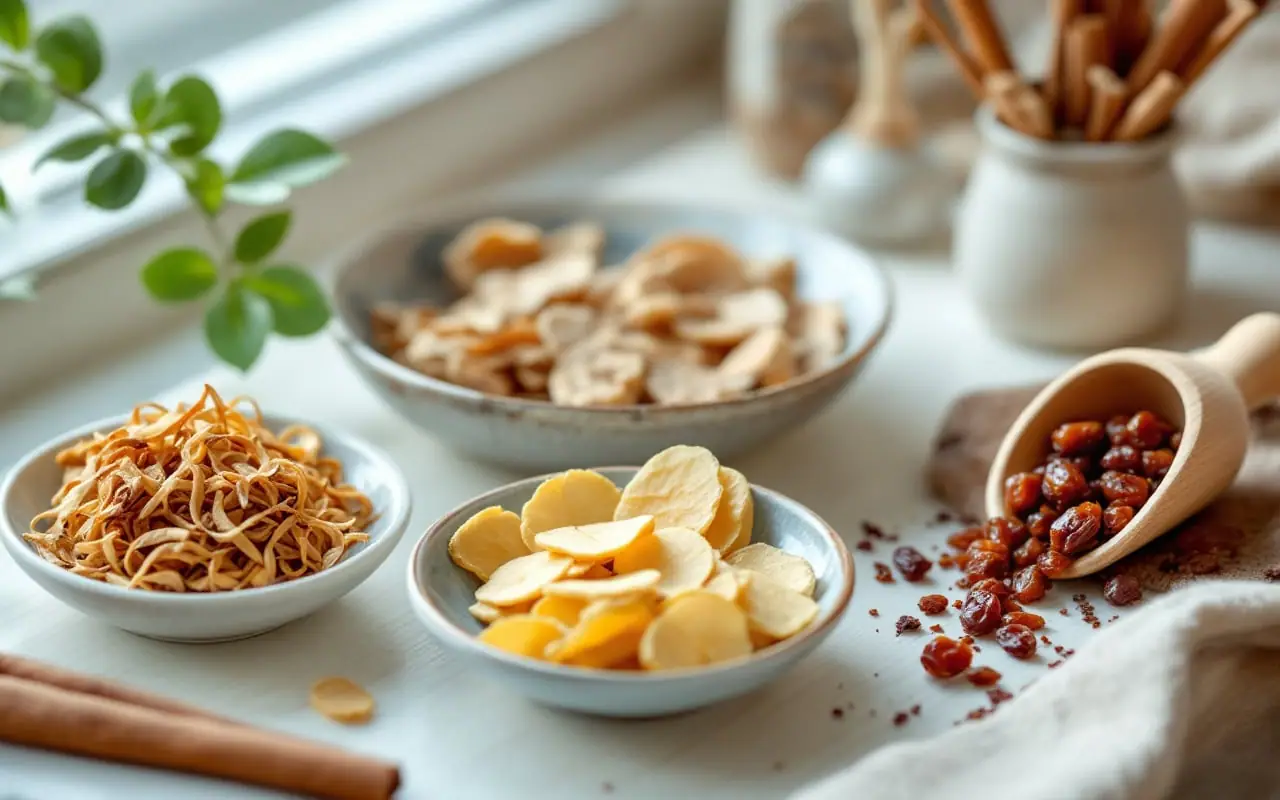
For many years I worked at the counter of a small family pharmacy in Kumamoto. Between the cold remedies and the shoulder plasters, the shop kept a wall of kampo: slim boxes of herbal granules, some sold over the counter, others dispensed on a doctor's prescription. The question I heard most often about them was some version of "It's natural, so it's gentle, isn't it?"
The honest answer is no, or at least not automatically. Kampo is a medicine. It has effects, it has side effects, and it can clash with other medicines. It is also a living part of ordinary Japanese health care, which surprises visitors who expect herbal medicine to sit on the fringe. Here is what it is, where it came from, how it is used, and how to stay safe around it.
A name that marks a border
Kampo means, roughly, "the Han method". The Han were the Chinese dynasty whose medical classics still sit at the root of the tradition. Chinese medicine reached Japan from around the fifth and sixth centuries, partly by way of the Korean peninsula, along with Buddhism, writing and a great deal else.
Japanese physicians reshaped what they had received. The name kampo came later, in the Edo period (1603 to 1868), when Dutch traders at Nagasaki brought European anatomy and surgery with them and that learning became known as "Dutch medicine". Calling the older tradition the Han method was a way of telling the two apart.
The eighteenth century produced an influential school that went back to the oldest formula texts, above all the Shanghan lun (Treatise on Cold Damage), compiled in China around the end of the Han dynasty. Its followers distrusted elaborate theory. Look at the patient, they said, feel the abdomen, and match the formula to what you find. That practical streak still marks Japanese kampo.
Then came a sharp break. After the Meiji Restoration of 1868, the new government modeled medical education on German medicine, and from the 1880s anyone who wanted a license to practice had to qualify in Western medicine. Kampo lost its official standing. A small number of doctors and pharmacists kept it alive, and it slowly revived during the twentieth century.
The turning point for everyday use came in 1967, when the first few kampo extract products were added to the national health insurance drug list. A much larger group followed in 1976. Today the figure usually given by Japan's kampo professional society, and repeated in medical reviews, is 148 prescription formulas covered by national health insurance. Japan's model curriculum for medical schools has included an introduction to kampo since the early 2000s, so most younger doctors have at least met it.
Kampo and Chinese medicine side by side
Kampo and traditional Chinese medicine (TCM) share ancestors and many herbs, so people outside Asia often treat them as one thing. In practice they have grown apart.
| Kampo in Japan | Chinese medicine in China | |
|---|---|---|
| Who prescribes | Ordinary licensed doctors; no separate kampo license | Mostly practitioners trained on a separate TCM track |
| Formulas | Mostly fixed classical recipes, used much as written | Often adjusted for each patient, with herbs added or removed |
| Usual form | Factory-made extract granules | Raw-herb decoctions still common, plus granules |
| Amount of raw herb | Generally smaller daily amounts | Generally larger |
| Examination | Strong emphasis on feeling the abdomen | More weight on pulse, tongue and classical theory such as the five phases |
The table simplifies, but the broad picture holds: Japanese kampo is standardized, pragmatic and folded into mainstream clinics, while Chinese medicine in China runs as a parallel system with its own hospitals and training.
What is actually in a formula
A kampo formula is a fixed combination of shoyaku (crude drugs). Most are dried plant parts: roots, rhizomes, bark, seeds, fruit peel. A few are minerals, such as gypsum, and a few come from animals, such as oyster shell. One formula might combine two ingredients, another more than a dozen. The classical idea is that the parts work as a team, with some ingredients there to balance or soften the others.
Traditionally the mixture is simmered in water and the strained liquid is drunk, and some specialist clinics still work this way. Most kampo today, though, comes as extract granules. Manufacturers make a decoction on an industrial scale, concentrate and dry it into powder, then granulate it into sachets or press it into tablets. Prescription extracts are made to pharmaceutical manufacturing standards, and the raw herbs have to meet the standards of the Japanese Pharmacopoeia. Most of those herbs are imported, mainly from China. A given product should contain the same thing from one box to the next, which is not always true of herbal products bought elsewhere.
How kampo is prescribed
In Japan there are two routes. The first is a prescription. Many family doctors and specialists use a handful of formulas alongside ordinary drugs, often for complaints that ordinary medicine handles awkwardly: cold hands and feet, menopausal symptoms, tiredness after an illness, leg cramps, and functional digestive complaints like the ones Naoko describes in her piece on bloating after meals. A smaller number of doctors specialize in kampo and spend much longer examining each patient. Either way, prescription kampo goes through a pharmacy like any other medicine.
The second route is over the counter. Japanese pharmacies and drugstores sell many formulas as nonprescription products, some at a lower strength than the prescription versions. The box describes the kind of person and the symptoms the formula traditionally suits. In my experience that description is where much of the trouble starts, because people read it like a horoscope and recognize themselves in it.
Sho: matching the formula to the person
The idea at the heart of kampo prescribing is sho, usually translated as "pattern" or "conformation". Sho is not a disease name. It is a snapshot of how your body is reacting right now: your build and strength, whether you run hot or cold, how you sweat, sleep, eat and digest.
Kampo teaches four ways of gathering this information. There is looking (complexion, posture, the tongue), listening and smelling (voice, breathing), asking (detailed questions about appetite, thirst, bowels, urine, sleep, periods and sensitivity to cold), and touching (the pulse and, especially in Japan, the abdomen). The findings are then sorted along a few broad lines. Is the person sturdy or depleted, a contrast kampo calls jitsu and kyo? Is the picture hot or cold? Is the problem mainly with ki (vital energy), ketsu (blood) or sui (body fluids)?
The pattern points to a formula. Two people with the same Western diagnosis can receive different formulas, and one formula can be used for quite different diagnoses if the pattern fits.
A well-known example shows how narrow this can be. Kakkonto is probably the most familiar formula in Japan. Traditionally it is used at the very start of a cold in someone who feels chilly, has a stiff neck and shoulders, and has not yet begun to sweat. Once the cold settles in and the picture changes, the traditional view is that it no longer fits. It also contains ephedra, which can raise heart rate and blood pressure, so it is not suitable for everyone even when the pattern seems right. Picking it off a shelf because "it's for colds" misses both points.
What the evidence says
Centuries of use tell you which formulas people found helpful. They do not tell you how well they work compared with a placebo, or how often they cause harm.
Japan has produced many randomized controlled trials of kampo, but their quality is uneven. Many trials are small, many are not blinded, and many are published only in Japanese. Systematic reviews generally rate the evidence for most uses as low to moderate in quality. Some areas, such as certain digestive symptoms, have been studied more than others, and even there the results are mixed.
Kampo is also hard to test. A trial gives everyone in a group the same treatment, while traditional prescribing gives different people different formulas, and the strong taste of the granules makes a convincing placebo difficult.
My own reading: there is enough research to take kampo seriously and not enough to treat most claims about it as proven. The US National Center for Complementary and Integrative Health is a sensible place to read about herbal products and their safety in general.
Safety: what can go wrong
Licorice root, kanzo in Japanese, appears in a large share of kampo formulas. Its active compound, glycyrrhizin, can cause a condition called pseudoaldosteronism. The body behaves as if it had too much of the hormone aldosterone: it holds on to salt and water and loses potassium. The signs are high blood pressure, swelling around the ankles or face, tiredness, muscle weakness or cramps, and palpitations. In severe cases low potassium can damage muscle or upset the heart rhythm.
The risk is higher in older people, with long use, with diuretics (water tablets) or steroid medicines, and when someone takes two licorice-containing products at once without realizing it. That might be two formulas, or one formula plus an over-the-counter cold remedy. Doctors who prescribe kampo for long periods often check potassium in blood tests for exactly this reason.
Ephedra, mao in Japanese, is in kakkonto and several other formulas. It can cause palpitations, sleeplessness, raised blood pressure and difficulty passing urine, and it needs extra care in people with heart disease, high blood pressure, thyroid problems or an enlarged prostate.
Rarer but serious reactions have been reported too. Several formulas have been linked to interstitial pneumonia, an inflammation of the lungs that shows up as a dry cough, breathlessness and fever. Drug-induced liver injury can cause tiredness, itching, yellowing of the skin or eyes and dark urine. Japanese reports have also linked long-term use of formulas containing gardenia fruit to a rare problem with the veins of the bowel. Rashes and stomach upset are more common and usually milder.
Then there are interactions. Kampo can affect, or be affected by, other medicines, and the details are not always known. In Japan your pharmacy records prescriptions in an okusuri techo (medicine notebook). It helps to write over-the-counter kampo and supplements in it too, so whoever looks at it sees the whole picture. Pregnancy, breastfeeding, kidney or heart disease, and planned surgery all call for a conversation before starting anything.
Outside Japan, kampo-style products are often sold as dietary supplements of varying quality, and some herbal products sold internationally have been found to contain heavy metals or undeclared drugs. A powder from an unfamiliar website is not the same thing as a Japanese prescription product.
Why I always said "ask first"
At the counter, when someone wanted a formula for a new or puzzling complaint, I sent them to the pharmacist or back to their doctor rather than letting the box decide. An article should not decide for you either. Choosing well needs a diagnosis first, then a look at your other medicines and health conditions, then a judgment about the pattern, and then someone keeping an eye on how you respond. Kampo should never be a reason to put off seeing a doctor about symptoms that are new, severe or getting worse.
If you are curious about trying it, this is what I would take along:
- A diagnosis from a doctor for the symptom you want help with.
- A full list of everything you take, including other herbal products, supplements and over-the-counter remedies.
- Three questions for the doctor or pharmacist: does this formula contain licorice or ephedra, how long should I take it before we review it, and which side effects should I watch for?
- A rule for yourself: one kampo product at a time, unless a doctor has deliberately combined them.
- A clear stop list. Stop and get medical advice promptly for swelling, muscle weakness, palpitations, a dry cough with breathlessness or fever, yellow skin or eyes, dark urine, or a spreading rash. Severe breathlessness or chest pain needs emergency care.
More pieces on these traditions are collected in the Kampo & Eastern Medicine section. If you keep one thing from this one, let it be this: kampo is real medicine, so give it the same care you would give any other.
The writer
Keiko spent many years at the counter of a family-run pharmacy in Kumamoto that stocked kampo medicines. She writes about kampo, acupuncture and the old idea of yojo, carefully and with the evidence in view.