Miso paste types: white vs red miso and how to choose
There are usually three tubs of miso in my fridge in Fukuoka, and friends from abroad who open it always ask why. The short answer is that miso paste is not one ingredient. It is a family of fermented soybean pastes that runs from pale, sweet and mild to nearly black, salty and deep, and each kind does a different job in the kitchen. This guide is for anyone buying miso for the first time, or standing at a chilled shelf wondering whether white or red is the right one. Three things decide it: what you will cook, how salty the miso is, and what is in the tub.
A note: links to Amazon here are affiliate links. As an Amazon Associate I earn from qualifying purchases.
If you only get one

Sweet white miso
Mild and lower in salt than red miso, in a squeeze tube that keeps it fresh in the fridge.
Amazon price at 23 Oct 2026, 04:32 UTC: $20.58
Product prices and availability are accurate as of the date/time indicated and are subject to change.
View on AmazonOr, if it suits you better: red rice miso or awase (mixed) miso, both on Amazon.
What is miso?
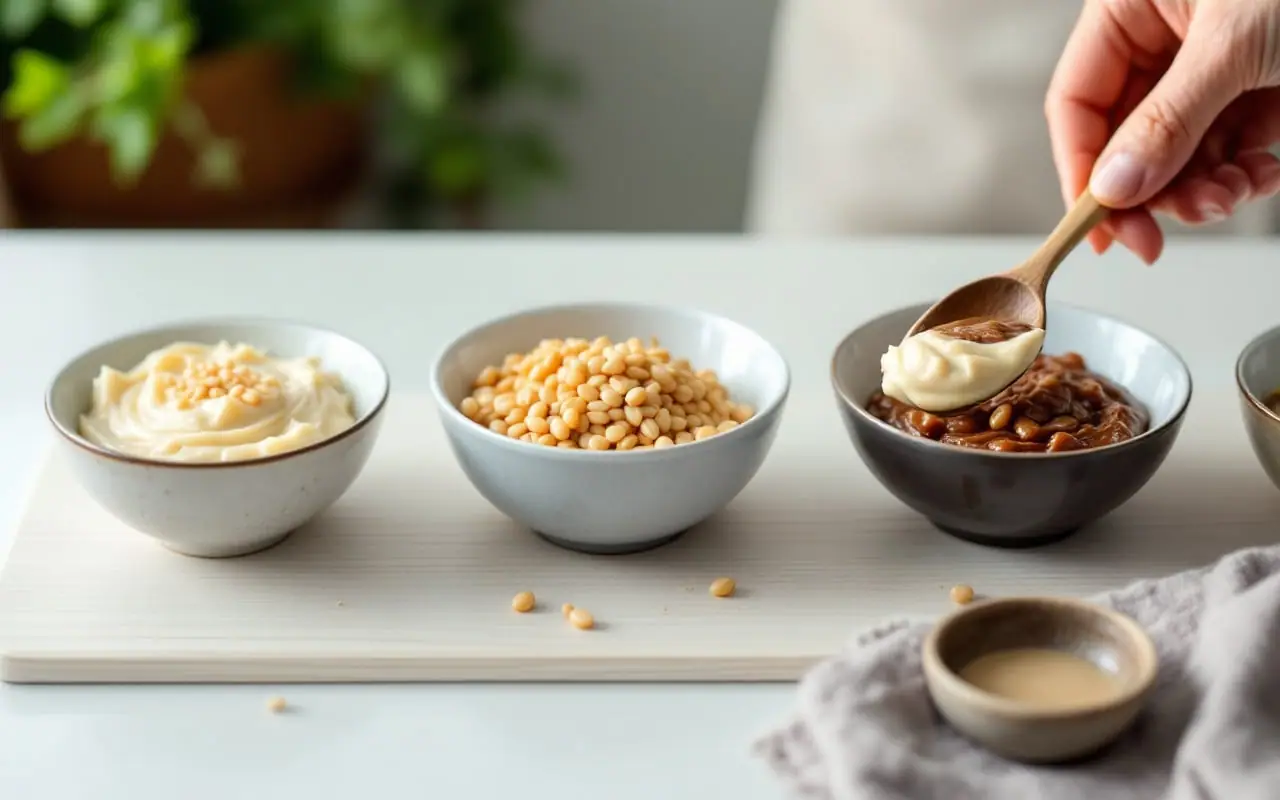
Miso is a paste of cooked soybeans, salt and koji: rice, barley or soybeans grown with a mold called Aspergillus oryzae. Mixed and packed away, it ferments for anything from a few weeks to two or three years. Enzymes from the koji break soybean protein into savory amino acids and grain starch into sugars, while the salt keeps unwanted microbes out.
In Japan, miso is sorted three ways at once:
- By the koji. Rice miso (kome miso) is the most common; barley miso (mugi miso) and soybean miso (mame miso) are regional; blends of these are their own category.
- By color. White, light-colored and red. The color comes from a slow browning reaction between sugars and amino acids, so longer aging, warmer storage, a higher share of soybeans, and steaming the beans instead of boiling them all make a darker miso.
- By taste. Amakuchi (sweet) or karakuchi (salty). More koji and less salt make a sweet miso that is ready in weeks; less koji and more salt make a saltier one that needs months.
So "white" and "red" describe color, not a recipe. A red miso can be made with rice or with soybeans; a sweet white one is almost always rice.
The map of Japan helps too. Kyoto is known for sweet white miso, Nagano for light-colored rice miso, the northeast for salty red miso, Aichi and its neighbors for dark soybean miso, and Kyushu, Shikoku and the western tip of Honshu for barley miso. Here in Fukuoka barley miso is the everyday kind, mild and a little sweet, with the flattened grains still visible.
What matters when you choose
What you will cook
Soup needs a miso with enough salt and depth to carry a bowl of dashi. Dressings and glazes need sweetness and a gentle color. Long-simmered dishes need a miso that does not fade with heat. If you buy one tub, buy it for the dish you make most often.
Salt
This is the biggest difference between types, and the one that matters for health. Sweet white miso has about half the salt of ordinary miso. Compare the sodium line on the label, per tablespoon, rather than trusting the color. Outside Japan, a tub labeled "white" or "shiro" can be either the sweet Kyoto kind or a pale everyday miso with twice the salt, and the label is the only way to tell them apart.
The ingredients list
The shortest list reads soybeans, rice or barley, and salt, sometimes with the koji named separately. Common additions are a little alcohol, which stops fermentation so the pack does not swell; dashi, in dashi-iri miso, which is convenient but no longer vegetarian and usually carries extra seasoning; and sweeteners in some white misos.
Raw or pasteurized
Nama (raw) miso has not been heated after fermentation and still holds live microbes. Pasteurized miso is steadier on the shelf and tastes much the same once it is in a hot soup. What live microbes in miso can and cannot do for you is a separate question, which I went through in miso, natto and nukazuke. For cooking, either is fine.
Allergies and diets
All miso contains soy. Barley miso contains gluten, and some rice misos are made on the same lines as barley ones, so a gluten-free diet needs a label that says gluten-free. Miso is plant-based unless dashi or bonito has been added.
Size and storage
Miso keeps for months in the fridge, but sweet white miso, with less salt to protect it, darkens and loses its fresh sweetness sooner. A large tub of an everyday miso makes sense if you cook with it most days; buy white miso in smaller amounts.
Salt and calories per tablespoon
| Miso | Salt per 100 g | Calories per tbsp | Sodium per tbsp | Salt per tbsp |
|---|---|---|---|---|
| Sweet white | 6.1 g | 37 kcal | 432 mg | 1.1 g |
| Light-colored rice | 12.4 g | 33 kcal | 879 mg | 2.2 g |
| Red rice | 13.0 g | 32 kcal | 921 mg | 2.3 g |
| Barley | 10.7 g | 33 kcal | 758 mg | 1.9 g |
| Soybean (hatcho style) | 10.9 g | 37 kcal | 772 mg | 2.0 g |
These figures come from Japan's Standard Tables of Food Composition (8th edition), with a tablespoon taken as about 18 g. Individual brands vary, so the label on your tub is the final word. To put them in context, one tablespoon of red miso is about 40 percent of the 2,300 mg of sodium a day that the US Dietary Guidelines set as an upper limit for adults. The miso soup calories and sodium calculator works out a whole bowl with your miso, dashi and add-ins.
The main kinds of miso
Red vs white miso: can you swap them?
Yes, with a little adjusting. Red miso is roughly twice as salty as sweet white and much stronger, so when a recipe asks for white and you only have red, use about half as much and add a little sweetness, such as a splash of mirin or a pinch of sugar. Going the other way, use more white miso than the recipe says and taste as you go; the dish will come out sweeter and paler, and a few drops of soy sauce bring back some depth. For soup, mixing the two is what many cooks do anyway, and that is all awase is.
Which miso for miso soup?
For everyday soup, awase or light-colored rice miso. For clams, pork or mushrooms, red. To soften a soup with sweet vegetables, swap in some white. My miso soup recipe uses awase or light-colored miso, at about 1 tablespoon per cup of dashi.
Is darker miso better for you?
Not in any way that matters at the table. Darker miso has been aged longer and tastes stronger, so you may use a little less, but per spoonful its salt is close to everyday light miso: red rice miso a little more, dark soybean miso a little less. Pick by taste and by the sodium line.
Who should take care
Miso is a seasoning, and most of its health story is about salt. If you have high blood pressure, kidney disease or heart failure, or your doctor has asked you to limit salt, ask your doctor or a dietitian how much miso fits your day; white miso and smaller spoonfuls help. Some reduced-salt products replace part of the salt with potassium chloride. That can be a problem for people with kidney disease or for those taking certain blood-pressure medicines that raise potassium, so check with a doctor or pharmacist before switching.
People taking an older type of antidepressant called an MAOI are told to limit aged and fermented foods, miso among them, because of a substance called tyramine; ask your pharmacist. Soy allergy rules out every kind of miso, and swelling of the lips, tongue or throat or trouble breathing after eating soy needs emergency help.
Keeping a tub
Keep miso in the fridge with the lid on and a piece of plastic wrap pressed onto the surface, and scoop with a clean, dry spoon. It darkens slowly over the months, which is harmless; the flavor just grows deeper. Sweet white miso keeps for less time, and it also does well in the freezer, where the sugar and salt keep it soft enough to scoop straight out.
Your first tub, in five lines
- Soup most days: awase or light-colored rice miso.
- Dressings, dips and glazes: sweet white miso.
- Hearty winter soups and braises: red miso.
- Read the sodium line, not the color.
- Start with one tub, and add a second once you know which way your cooking leans.
How these picks were made
The kinds of miso and the example tubs in this guide were chosen from their ingredients, specifications, maker information and other published information, with salt and calorie figures from Japan's food composition tables. We did not taste or try these products for this guide.

The writer
Naoko is a food and nutrition writer from Fukuoka who studied nutrition before she took up writing. She covers gut health and everyday eating, and most of her ideas start at the kitchen counter.