Lemongrass essential oil: uses, citral and safe skin levels
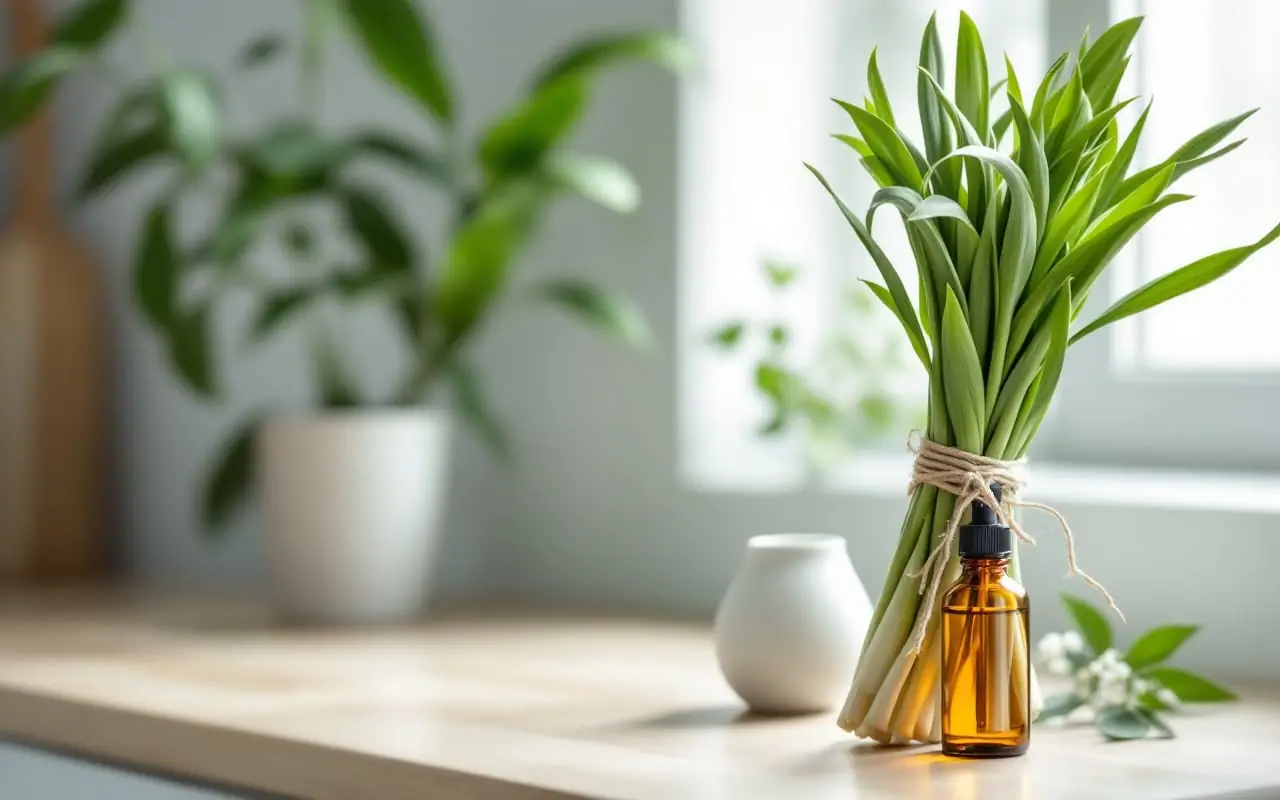
Lemongrass essential oil is steam distilled from the leaves of two tropical grasses, Cymbopogon citratus and Cymbopogon flexuosus. It smells of lemon peel and freshly cut grass, strongly enough that one drop announces itself across a room, and it is one of the least costly and most useful oils for a summer diffuser or a homemade cleaning spray. On skin it needs more care than most. Its main component, citral, can sensitise skin, so safety references give lemongrass a ceiling of about 0.7 percent. In practice that means 1 drop in 10 ml of carrier oil.
Here is that ceiling in drops, since it is the number most people come looking for:
| Finished blend | 0.7% works out at | Drops of lemongrass |
|---|---|---|
| 10 ml (2 teaspoons) | 1.4 drops | 1 |
| 30 ml (2 tablespoons) | 4.2 drops | 4 |
| 50 ml | 7 drops | 7 |
| 100 ml | 14 drops | 14 |
Those figures assume the usual aromatherapy convention of 20 drops to the millilitre. They are the maximum for healthy adult skin on the body, not a target, and they are lemongrass's share of a blend, not something added on top of your other oils. I leave lemongrass out of face blends, baths and anything for children. The dilution calculator works out other sizes.
Two grasses, one oil
West Indian lemongrass, C. citratus, is the stalky plant sold in bundles for Thai and Vietnamese cooking, which turns up in many Japanese supermarkets now. East Indian lemongrass, C. flexuosus, is grown mainly in India and gives a large share of the oil traded for perfumery and aromatherapy. The two oils are close. Both are usually somewhere around three quarters citral, and the West Indian type often carries a little more myrcene, which gives it a slightly earthier, less sparkling note.
Lemongrass has relatives on the oil shelf. Citronella (Cymbopogon nardus and C. winterianus) is a cousin with a coarser smell, and palmarosa (C. martinii) smells surprisingly of rose. They are different oils with different chemistry, so do not swap one for another in a recipe.
A pot of lemongrass on a sunny balcony in Fukuoka grows happily through a humid summer and sulks in winter, when it is better brought indoors. The fresh stalks are a joy in the kitchen. The oil is not food, though, and nothing about the herb makes the distilled oil safe to swallow.
Why lemongrass has a ceiling: citral explained
Citral is a pair of closely related aldehydes, geranial and neral, that give lemongrass, lemon verbena, melissa and Litsea cubeba (may chang) their lemony smell. It is also widely used in perfumes and lemon-scented household products, and European cosmetics rules list it among the fragrance allergens that must be named on ingredient labels.
Two different things can happen when citral meets skin. Irritation is immediate: redness and stinging where the oil touched, which fades once you stop. Sensitisation is slower and lasts. The immune system learns to treat citral as a threat, usually after repeated use, and from then on even small amounts can set off an itchy, eczema-like rash, often for life. Someone sensitised by a strong homemade lemongrass massage oil may later react to lemon-scented shampoo, washing-up liquid or perfume.
The 0.7 percent figure comes from Robert Tisserand and Rodney Young's reference book Essential Oil Safety, which bases it on a safe skin level for citral and the amount of citral lemongrass contains. You may read online that mixing lemongrass with a citrus oil "quenches" the citral and makes stronger dilutions safe. That idea came from early experiments that later work has not supported well, so keep to the ceiling whatever else is in the bottle.
Sunlight, at least, is not a problem. Despite the name, lemongrass is not a citrus peel oil and is not phototoxic. Age is the bigger worry. Citral breaks down as the oil meets air and warmth, and a tired bottle smells flat or faintly soapy. Buy small and keep it cool, dark and tightly capped.
Making a lemongrass body oil, step by step
- Choose the total strength first. For a body oil used now and then, 2 percent is plenty, which in 30 ml is 12 drops in total.
- Give lemongrass no more than its share: 4 drops in 30 ml.
- Make up the rest with gentler oils. Lavender and geranium both soften lemongrass well, so 4 drops of each brings you to 12.
- Measure 30 ml of carrier oil into a clean glass bottle, add the drops, cap it, roll it gently, and label it with the oils, the strength and the date.
- Patch test on the inner forearm and wait 24 to 48 hours before using it more widely.
- Use it on unbroken skin only, and stop at the first itch.
My dilution chart walks through the same method for the other oils that come with their own limits.
Diffusing and cleaning: where lemongrass shines
Lemongrass earns its place in the cupboard away from skin. In a small ultrasonic diffuser, 1 or 2 drops are enough, ideally with 2 or 3 drops of something softer such as lavender, sweet orange or Atlas cedarwood. Run it for 30 to 60 minutes and then switch it off. If eyes sting or anyone starts coughing, open the windows.
For cleaning, about 10 drops in 250 ml of water with a teaspoon of unscented washing-up liquid to help it mix makes a pleasant spray for worktops and floors. Shake it before each use, wear gloves if your hands are sensitive, and skip it on surfaces where a cat walks and then licks its paws. In lab dishes lemongrass oil kills many bacteria and fungi, but a spray bottle of it is not a disinfectant. For raw meat juices, or when someone in the house has a stomach bug, use a proper cleaning product.
Does lemongrass oil keep mosquitoes away?
A little, and briefly. Lemongrass and citronella oils do put mosquitoes off in laboratory tests, but they evaporate fast, so protection fades much sooner than with registered repellents, and putting enough on your skin to matter would take you well past the citral limit. In Japan the striped tiger mosquito bites in broad daylight through the summer. For that, and for travel anywhere mosquitoes carry disease, the US CDC recommends registered repellents with ingredients such as DEET, picaridin (also called icaridin) or IR3535; its advice is at cdc.gov. A lemongrass diffuser on the veranda is a nice smell, not protection.
What else does the research say?
Most lemongrass research happens in lab dishes, where the oil and citral act against many fungi and bacteria. Human studies are few and small: a handful of trials of lemongrass mouthwashes for gum inflammation, and a study in which healthy young men who smelled lemongrass before a stressful task reported feeling a little less anxious than men given a comparison scent. None of this is strong enough to treat anything with. Athlete's foot, a fungal nail or sore, bleeding gums are better taken to a pharmacist or dentist, who can offer treatments with proper trials behind them.
Who should avoid lemongrass on skin
- Children. I keep it off children's skin altogether, and diffuse it only lightly and briefly in rooms they use.
- Pregnancy. In animal studies, large amounts of citral given by mouth affected the developing young. Nobody knows what low-level skin use means in a human pregnancy, so I would keep lemongrass to the diffuser, or leave it out, and ask a midwife.
- Eczema, very sensitive skin, or broken or inflamed skin. Leave it out.
- Asthma. Diffuse lightly if at all, and stop at the first wheeze.
- Pets. Never on a pet. The ASPCA, whose plant lists are at aspca.org, counts the lemongrass plant itself as toxic to cats, dogs and horses, and cats in particular should never be shut in a scented room. My piece on essential oils around children and pets covers diffusing in a home with animals.
- Anyone at all, by mouth.
A rash that spreads, blisters or keeps coming back deserves a doctor's visit: a patch-test clinic can tell you whether you have become sensitised to citral and which products to avoid from now on. If oil splashes into an eye, rinse with clean running water for at least 10 minutes. If a child swallows lemongrass oil, do not make them sick; contact a doctor or poison information service at once, and call 119 in Japan (or your local emergency number) for drowsiness, choking, coughing fits or trouble breathing. The essential oil safety chart lists lemongrass with the other skin sensitisers.
Choosing a bottle
- The Latin name, Cymbopogon citratus or C. flexuosus, and the country of origin.
- Dark glass with a dropper insert, in a 10 ml size. At 1 or 2 drops a time, that lasts a long while.
- Pale yellow to amber oil with a bright smell of lemon and grass. Flat, soapy or sour means old. A drop on a paper blotter strip beside your last bottle is the easiest freshness check.
- A price in line with other everyday oils. Lemongrass is inexpensive, so there is little reason to cut it, but it is itself a common adulterant: cheap lemongrass is used to stretch costly melissa (lemon balm) oil. A "melissa" that smells of lemongrass at a lemongrass price is lemongrass.
- No "fragrance oil" on the label. Lemongrass fragrance oil is perfume, made for candles and soap, not for skin.
For most households, a 10 ml bottle of lemongrass essential oil covers a whole summer of diffusing.
Oils that soften and suit it
- Lavender and geranium, to round off its sharpness
- Atlas cedarwood or vetiver, for an earthy base
- Sweet orange, for a sunny diffuser blend
- Ginger, for warmth
- Rosemary, for a crisp kitchen blend
Keep one picture of lemongrass in mind: a strong friend for the diffuser and the kitchen counter, a careful single drop in 10 ml on adult skin, and nothing at all for children's skin or the bath.

The writer
Philippa is a British writer who has lived in Japan for many years and has blended essential oils at home for two decades. She looks after the Aroma corner and never writes a recipe without the dilution.