Reed diffuser sticks: how to choose reeds and when to change them
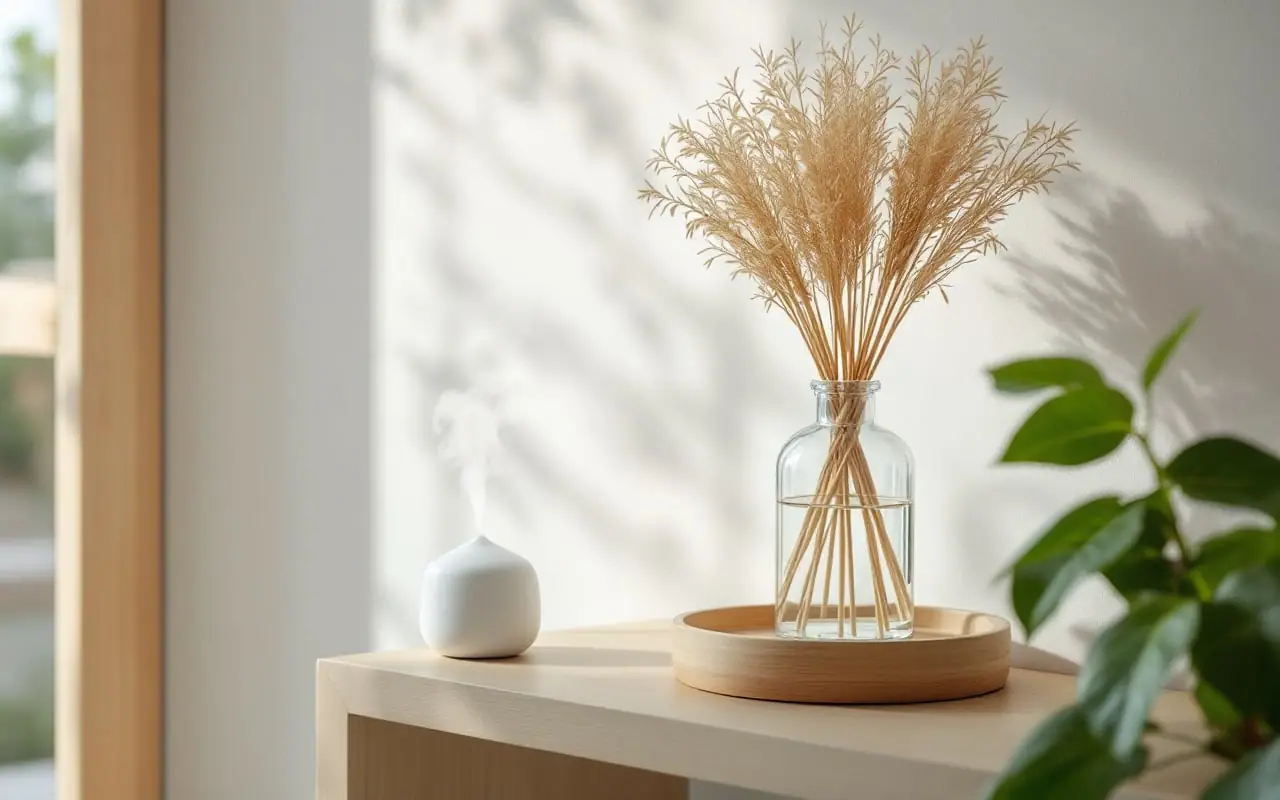
Reed diffuser sticks do one job: they carry scented liquid up from the bottle so it can evaporate from the tips. When a reed diffuser stops smelling of anything long before the bottle is empty, the reeds are the usual reason, not the oil. This guide is for anyone refreshing a tired reed diffuser or filling an empty bottle for the first time. It covers what the reeds are made of and how each kind wicks, the length and number that suit your bottle and room, how often to turn them, and when to give up and fit a new set.
If you are still deciding between reeds and a plug-in diffuser, start with my comparison of reed diffusers and electric diffusers. This page assumes you have chosen reeds.
How reeds wick
Rattan comes from climbing palms, mostly grown in South-East Asia. Reed sticks are cut from the cane and are full of fine channels running from one end to the other, like a bundle of drinking straws too narrow to see. Liquid creeps up those channels and spreads over the part of the reed standing in the air, where it evaporates. The amount of scent a diffuser puts into a room, which the trade calls its throw, depends mostly on how much wet reed surface sits above the neck.
Fibre reeds do the same job with bundled synthetic fibres instead of plant channels. Because the fibres are uniform, they wick evenly and clog more slowly than rattan, which makes them useful for thicker blends. They look less natural, often come in white or black, and still need replacing in time.
| Natural rattan | Fibre (synthetic) | Bamboo or wooden skewers | |
|---|---|---|---|
| How it wicks | Fine channels end to end | Even channels between fibres | Hardly at all: solid joints block the flow |
| Scent | Good when fresh, fades as channels fill | Steady, even | Faint |
| Clogging | With dust and the heavier parts of a blend | More slowly | Not relevant |
| Look | Pale, natural, slightly uneven | Smooth, often white or black | Natural, but a poor wick |
| Suits | Most home blends | Thicker blends; anyone who dislikes changing reeds often | Decoration only |
What matters when choosing reeds
- Material. Plain rattan for most blends; fibre if your blend is thick or your reeds clog quickly. Avoid reeds sold already scented, since you cannot tell what is in them.
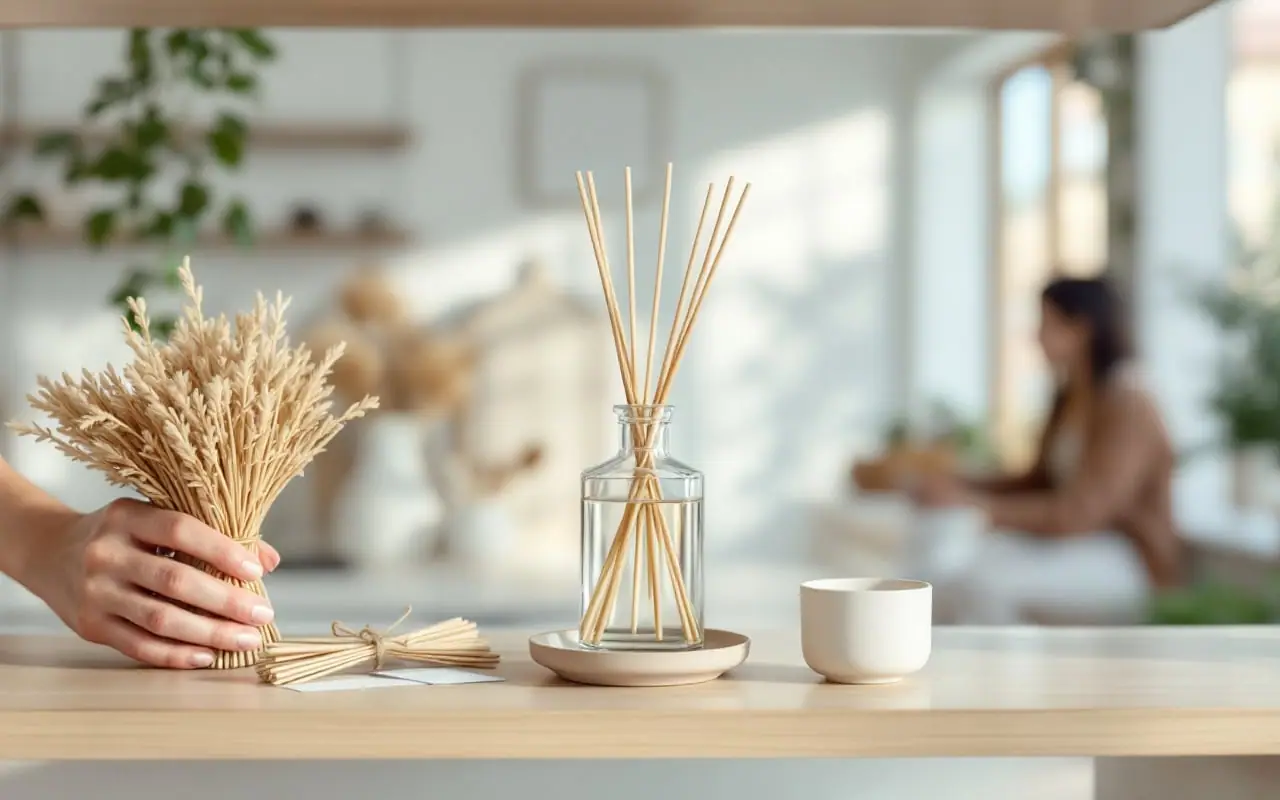
- Length against the bottle. A common rule of thumb is reeds about twice the height of the bottle, so roughly half of each one stands clear of the neck. Too short and there is little wet surface; too long and a light bottle tips over at the first nudge. Rattan trims easily with strong scissors or secateurs, and a clean cut wicks better than a crushed end.
- Thickness. Thicker reeds carry more liquid each and give more throw per reed. Most packs are a single standard thickness, so the number of reeds is the easier dial to turn.
- The bottle neck. A narrow neck holds the reeds in a neat fan, lets less liquid evaporate straight from the surface and spills less when knocked. A wide mouth makes the reeds splay and the liquid go faster. The neck should take your reeds without squeezing them, since a crushed reed wicks poorly.
- Fresh, untreated reeds for each new blend. Old reeds carry the old scent, and there is no good way to clean them.
The options
How many reeds for the room?
More reeds mean more wet surface, a stronger scent and a bottle that empties sooner. Doubling the reeds will not make the room smell twice as strong, because noses tire, but the liquid will go a good deal faster.
| Where | Reeds to start with |
|---|---|
| A toilet room, washroom or genkan (the entrance hall where shoes come off) | 3 to 5 |
| A larger room, a landing or an open hallway | 6 to 8 |
Start at the low end, live with it for a few days, then add one or two if you want more. Taking reeds away is just as useful: if a reed diffuser gives you or anyone else a headache, fewer reeds is the first fix to try. Heat, sunlight and a draught all speed evaporation, so a bottle by a sunny window or a heater goes noticeably faster, and the lighter notes in the blend leave first.
Turning the reeds
When the reeds first go in, leave them for a few hours to soak through, then turn them over once so the wet ends are at the top. That gives the first burst of scent. After that, turn them about once a week, or when the scent fades.
Turning more often gives you more scent for a day but empties the bottle faster. Turn them over the sink, holding a paper towel under the tips, because the drips are neat blend. Wash your hands afterwards, and wipe any drips at once: essential oils and alcohol can mark varnished, lacquered or painted wood for good. Keep the bottle on a glass or ceramic saucer for the same reason.
When reeds clog, and when to change them
Rattan fills slowly with household dust and with the heavier, stickier parts of a blend. The signs are easy to read once you know them:
- Turning the reeds no longer brings the scent back, even for a day.
- The tips stay pale and dry while the bottle still has plenty of liquid.
- The reeds have darkened along their length, or feel sticky or stiff.
- The level in the bottle has stopped dropping.
Then it is time for a new set. As a habit, change the reeds with every new blend and at least every refill or two. In a dusty or humid corner, expect to do it sooner. Thick oils such as vetiver, sandalwood or myrrh clog rattan quickly, so keep them to a small share of any blend or use fibre reeds.
Making a reed blend at home
The base matters more than people expect, because it has to travel up the reed. Many home recipes use a light carrier thinned with a little alcohol, or a dedicated reed diffuser base sold for the purpose. In Japan, most home recipes use musui etanoru (anhydrous ethanol) from the drugstore. Skip water, which does not mix with essential oils, and heavy kitchen oils such as olive, which barely move up a reed and go rancid.
Keep the essential oil share modest. About 10 percent of the bottle gives a gentle blend: in a 100 ml bottle that is 10 ml, two teaspoons, roughly 200 drops, so measure by spoon rather than counting. I would not go past 15 to 20 percent. More oil mostly means more concentrated liquid standing in the house, not a nicer room. The full recipe, with amounts, is in my reed and electric diffuser comparison.
Before mixing a whole bottle, try the blend on paper. A couple of drops of each oil, in proportion, on a pack of plain paper scent strips shows you over a day how it will smell as the lighter notes leave. If you have no oils yet, a set of six single essential oils in small bottles lets you find out what you like before you buy larger bottles. Check each oil against the essential oil safety chart first: some should stay out of a home with young children or cats.
Fragrance oils or essential oils?
Most shop reed diffusers use fragrance oils: scents built from synthetic and sometimes natural materials, dissolved in a solvent made to wick. They are formulated to last and to smell the same from the first week to the last, and they come in scents no plant could give you. Essential oils are distilled or pressed from plants. A reed blend made from them changes over the weeks as the light top notes go, and it costs more to make strong.
Neither kind is automatically gentler. "Natural" does not mean harmless, and many essential oils are among the ingredients of most concern for cats. Some people get headaches or a scratchy throat from both. The honest difference is control: with your own blend you know every ingredient and its strength. With a bought one, read the warnings on the box, which in Britain and Europe often cover allergic skin reactions and eye irritation.
Where the bottle should stand
- High, stable and away from the edge, out of reach of children and pets. A reed sucked like a lolly, or a mouthful of liquid, is a real route to poisoning.
- Away from candles, a gas hob, heaters and open flames. The alcohol in many bases is flammable, and dry reeds catch easily.
- Out of direct sun, which speeds evaporation and spoils the oils.
- On a saucer or tray, with a non-slip mat underneath if you live with earthquakes, as everyone in Japan does.
- Refill liquid and spare oils belong in a closed cupboard. If small children can reach it, simple strap locks for cupboard doors keep it shut.
When an electric diffuser makes more sense
Reeds never switch off. They scent the air while you sleep and while you are out, and they do little in a large room. An electric diffuser with a timer suits a living room or a bedroom before sleep, where you want a clearer scent for half an hour and then fresh air. It is also the better tool for anyone sensitive to smells, because you control when it stops. My guide to choosing an essential oil diffuser covers the types. In a home with a cat, a crawling baby or someone with asthma, think hardest of all: reeds never stop and can be knocked over, an electric diffuser can be switched off, and going without is a perfectly good choice too.
Who should take care, and when to get help
Cats clear many essential oil compounds slowly, and a knocked bottle means neat oil on fur and paws that the cat then licks: treat that as a vet emergency. Birds should not share scented air at all. My guide to essential oils around children and pets lists the oils of most concern and the emergency steps.
If anyone swallows reed liquid or essential oil, do not make them vomit. Call for poison advice at once, even if they seem well, and call 119 in Japan (or your local emergency number) for coughing, choking, drowsiness, trouble breathing or a fit. Wash liquid off skin with mild soap and plenty of water, and rinse an eye with lukewarm running water for 15 minutes. If you have asthma, ask your doctor before scenting your home, and if headaches keep coming even after you take the reeds out, they deserve a doctor's appointment rather than a new scent.
How the products on this page were chosen
The reeds, bottles, oils, scent strips and cupboard locks mentioned here were picked from their specifications, materials, maker information and published reviews. We did not test them, and nothing on this page comes from hands-on trials of particular products. When you shop, check the reed length against your bottle's height, whether the reeds are plain and untreated, and that bottles are glass.

The writer
Philippa is a British writer who has lived in Japan for many years and has blended essential oils at home for two decades. She looks after the Aroma corner and never writes a recipe without the dilution.