Sandalwood essential oil: Indian, Australian and how to buy well
Walk up the approach to almost any large temple in Japan and somewhere along the way you will pass an incense shop and smell byakudan (sandalwood) before you see it. It is in the incense sticks, in the little nioi-bukuro (scented sachets) people tuck into drawers and kimono chests, and in the beads of some Buddhist rosaries. For me it is the smell of quiet.
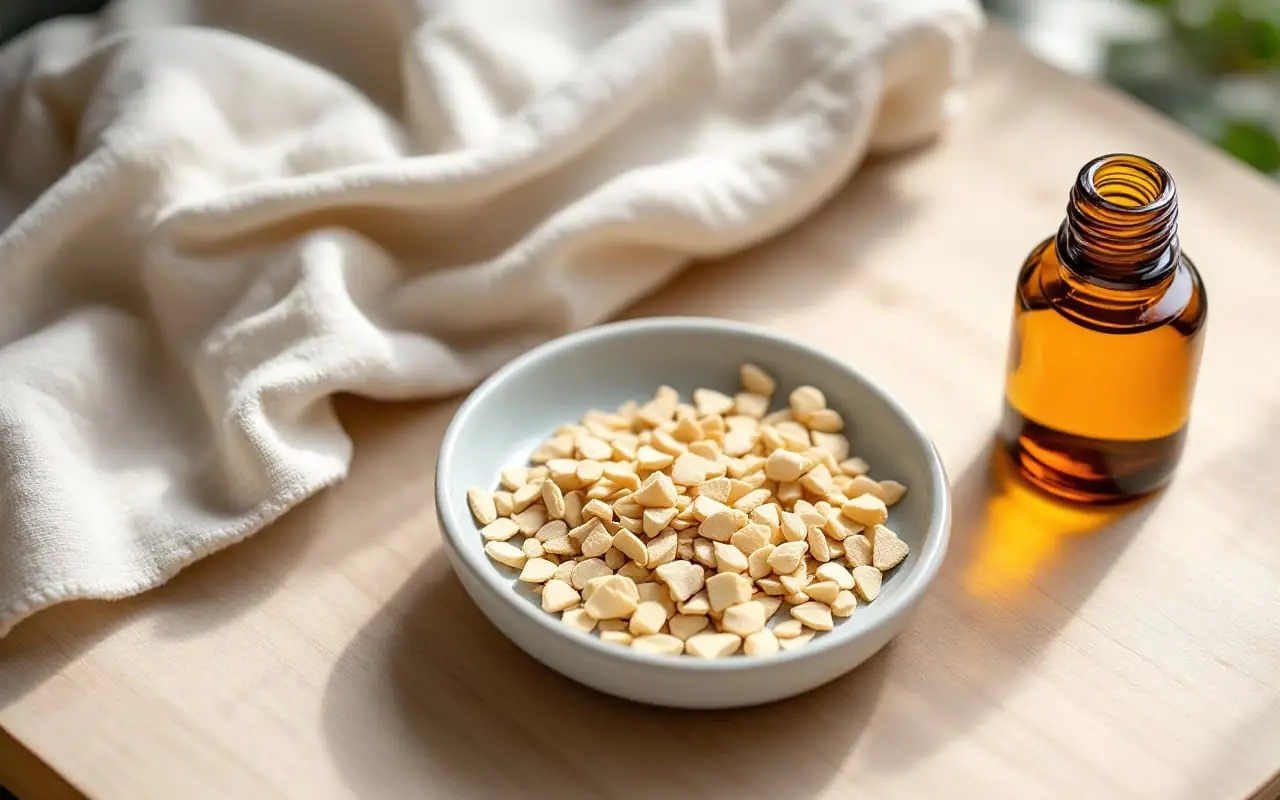
Sandalwood essential oil is steam distilled from the heartwood, and sometimes the roots, of trees in the genus Santalum. It smells soft, creamy, woody and faintly sweet, and it lingers on skin and paper for hours longer than most oils, which is why perfumers lean on it as a base note. The traditional oil is Indian sandalwood, Santalum album. Most of the sandalwood sold for home aromatherapy today is either Australian sandalwood, Santalum spicatum, or S. album grown on plantations, and a fair share of what is labelled sandalwood is not sandalwood at all. With this oil, the species and the source matter more than with almost any other bottle you will buy.
A slow tree
Sandalwood trees are partly parasitic. Their roots tap into the roots of neighbouring plants for water and nutrients, one reason they are hard to grow in tidy rows. The scented oil builds up in the heartwood, the dense core of the trunk, and only as the tree ages. Plantation trees are usually grown for at least 15 years before harvest, and wild trees were traditionally cut much older. Because so much of the oil sits in the core and the roots, trees are often pulled up whole rather than felled. The wood is then chipped or powdered and distilled slowly.
The main scent compounds are the santalols, and good Indian sandalwood oil is made up mostly of them. Australian sandalwood has fewer santalols and more of other compounds, which gives it a drier, slightly resinous and sometimes sharp opening. After a few minutes on the skin it softens into something much closer to the Indian oil.
Indian, Australian and the stand-ins
| Oil | Botanical name | Where it comes from | Scent | Notes |
|---|---|---|---|---|
| Indian sandalwood | Santalum album | Southern India, Indonesia, and now plantations in northern Australia | Rich, creamy, milky wood that lasts for hours | The classic perfume oil and the wood behind byakudan. Wild trees are overharvested |
| Australian sandalwood | Santalum spicatum | Western Australia, from licensed wild harvest and plantations | Drier and lighter, a resinous opening, then soft wood | The usual sandalwood in home aromatherapy ranges, at a much lower price than Indian |
| Pacific sandalwoods | Santalum austrocaledonicum and related species | New Caledonia, Vanuatu and other Pacific islands | Close to Indian | Smaller producers, often from village plantings |
| "West Indian sandalwood" | Amyris balsamifera | The Caribbean and northern South America | Faint, dry, woody, a little smoky | Not a sandalwood at all. A decent oil in its own right, but a common stand-in |
The sustainability question
Indian sandalwood has been traded for thousands of years, and in the twentieth century it was cut far faster than it could grow back. In southern India sandalwood trees were long treated as state property, with felling and sale tightly controlled, and a large smuggling trade grew up regardless. The old centre of the trade was Mysore, in Karnataka, and "Mysore sandalwood" is still used as a selling phrase. Wild Santalum album is now listed as vulnerable on the international red list of threatened species. Indian states have since loosened their rules to encourage farmers to plant it, and plantation oil from India and from northern Australia now supplies much of the legitimate market.
Australian sandalwood has its own history. Western Australia has exported it, mainly for incense in Asia, since the nineteenth century, and the state licenses the wild harvest. There is ongoing worry about whether wild stands are regenerating, because grazing animals and dry years take the seedlings, and plantations have been planted to take some pressure off.
So, for a bottle with a clear conscience: choose plantation-grown Indian sandalwood with a stated origin, or Australian sandalwood from a seller who can say whether it comes from licensed wild harvest or from plantations. Be wary of "wild Mysore sandalwood" at an everyday price.
How sandalwood gets faked
Real Indian sandalwood is among the most expensive oils most of us will ever buy, so it is one of the most adulterated. These are the usual tricks:
- Australian or Pacific sandalwood sold as Indian, or a mixture passed off as one.
- Amyris oil, sold as "sandalwood" or mixed in.
- Synthetic sandalwood molecules from the perfume industry. They smell convincing on the first sniff but lack the soft depth of the real thing as it dries down.
- A thin, almost odourless solvent or a plain vegetable oil added to stretch the bottle.
- "Sandalwood fragrance oil" or "sandalwood aroma oil", which is perfume rather than plant oil.
International quality standards set minimum santalol levels for sandalwood oils, and a seller of the genuine article can usually supply an analysis for the batch. If they cannot, or if "pure Indian sandalwood" costs about the same as lavender, assume something is wrong. A bottle honestly labelled "sandalwood 10% in jojoba" is fine, and often the sensible way to buy it. As with any oil, look for dark glass, a dropper insert and a batch number.
Using sandalwood at home
Sandalwood is a skin and perfume oil more than a diffuser oil. It is thick and slow to evaporate, so in an ultrasonic diffuser it gives only a faint background note, and it can gum up the nozzle of a waterless nebulizing diffuser. My habits with it:
- Body or massage oil: 1 to 2 percent, which is 2 to 4 drops in 10 ml of carrier oil.
- Face oil: 0.5 to 1 percent, or 1 to 2 drops in 10 ml. Jojoba suits sandalwood well, and the carrier oil chart helps if you want something richer for dry skin.
- Roll-on perfume: up to 2 percent, 4 drops in a 10 ml glass roller bottle, for the wrists or behind the ears. Sandalwood stays close to the skin, so a little goes far.
- Diffuser: 1 drop alongside 2 or 3 drops of a lighter oil such as sweet orange or lavender, for 30 to 60 minutes and then off.
- Bath: 3 drops stirred into a tablespoon of unscented bath dispersant or shower gel, added once the bath is full.
The easiest way to get to know it is on paper. Put a drop on a blotter strip and smell it straight away, again after an hour and again the next morning. Good Indian sandalwood often smells fuller and softer the next day than when you started, and that slow change is a useful test of quality. The guide to blending factors explains why long-lasting base notes like this one need fewer drops than you might think.
What we know from research
Not much. Laboratory and animal work has looked at alpha-santalol, one of the main components, mostly for its effects on skin cells. A few small human studies on sandalwood and mood or alertness have given mixed results, some pointing towards calm and some towards arousal, depending on whether the oil was smelled or applied to the skin. You may also read that skin cells carry smell receptors that respond to sandalwood. That laboratory work used a synthetic sandalwood molecule rather than the essential oil, and it tells us nothing yet about putting the oil on your face. The scent itself is reason enough to own a bottle.
Safety
Sandalwood is among the gentler oils on skin, but not risk-free. Skin allergy to sandalwood oil is uncommon but recognised, so patch test a new blend on your inner forearm for 24 to 48 hours. Synthetic sandalwood fragrances and solvent-stretched oils are an unknown quantity, which is one more reason to buy from a seller who states exactly what is in the bottle.
- Pregnancy and breastfeeding: no specific hazard is known. Keep to 1 percent or less and check with your midwife.
- Children: nothing on babies' skin. For children over about two, 0.5 to 1 percent at most.
- Pets: never on a pet, and keep blends and roll-ons out of reach. Cats groom off whatever lands on their fur, and their bodies clear many plant compounds poorly.
- Never swallow sandalwood oil.
Ask a pharmacist or doctor about any rash that spreads, blisters or will not settle. If oil gets in an eye, rinse it with clean running water for at least 10 minutes, and get advice if it still hurts or your sight is blurred. If a child drinks from a bottle, do not try to make them vomit; contact a doctor or poison information service straight away, and call 119 in Japan (or your local emergency number) for drowsiness, coughing or trouble breathing.
Blending partners
- Rose, for the most classic perfume pairing there is
- Frankincense, for a calm, resinous blend (see my frankincense profile)
- Bergamot FCF or yuzu (Japanese citron), for a brighter top note; on skin, give pressed yuzu the same sun care as lemon
- Lavender or geranium, for an everyday body oil
- Ylang ylang, one drop only, for something richer
- Hinoki (Japanese cypress), which together with sandalwood smells to me like the inside of an old wooden temple hall
If you buy a bottle of Australian sandalwood oil, you get a soft, long-lasting base note for a fraction of the cost of Indian, and a clear conscience if the seller can tell you where it grew. Whichever you choose, the last check before you pay is the same: the Latin name, the country, and a price that makes sense for a scent that took a tree fifteen years or more to make.

The writer
Philippa is a British writer who has lived in Japan for many years and has blended essential oils at home for two decades. She looks after the Aroma corner and never writes a recipe without the dilution.