Aromatherapy / Health & Living
Essential oils for sleep: what helps and what the research shows
Japan has a reputation as one of the most sleep-short countries in the developed world, and in Fukuoka I hear about it constantly: the late train home from Tenjin, the work dinner that runs past ten, the phone in bed. So it is no surprise that pillow mists and bedtime sprays sit near the registers of drugstores and variety shops here. People want to know whether essential oils for sleep actually work, and which oil to buy.
The short answer: lavender is the oil with the most research behind it, and the studies suggest a small benefit at best, mostly in how well people say they slept. A pleasant scent can be a useful part of a wind-down routine. It is not a sleep treatment, and it will not fix insomnia, sleep apnea or a schedule that leaves no room for sleep. The habits come first, so that is where this piece starts.
Habits that matter more than any oil
Doctors call these sleep hygiene. They are unglamorous, and they have far more evidence behind them than any scent. The CDC says adults need at least seven hours a night. Japan's health ministry, in its 2023 sleep guide, suggests adults aim for at least six hours and that older people avoid spending much more than eight hours in bed. Both point the same way: protect the time first.
- Get up at the same time every day, weekends included. A fixed wake time does more to steady your body clock than a fixed bedtime.
- Get daylight early. Open the curtains as soon as you wake, or walk part of the way to the station.
- Watch the caffeine. Sencha, matcha, canned coffee from a vending machine and energy drinks all count. Many sleep guides suggest stopping caffeine by early afternoon. Mugicha (roasted barley tea) has none, which is one reason Japanese households drink it by the jug.
- Go easy on alcohol at night. A drink can help you drop off, but it tends to break up sleep in the second half of the night.
- Take a warm bath an hour or two before bed rather than right before. A 2019 review of studies on evening bathing found that a warm bath or shower one to two hours before bedtime was linked with falling asleep a little faster. The long Japanese soak in the ofuro (home bath) fits this well.
- Keep the bedroom dark, quiet and cool. In a humid Kyushu summer that means using the air conditioner at night, especially for older people, who are at real risk of heatstroke indoors.
- Give yourself a wind-down: 30 to 60 minutes without work email or scrolling. This is where a scent can fit.
- If you have been lying awake for what feels like 20 minutes, get up, do something quiet in dim light, and go back when you feel sleepy. Lying there frustrated teaches the brain that bed is a place for being awake.
What the research says about essential oils and sleep
Most studies on aromatherapy and sleep test lavender, and they share the same weak spots. They are small, often a few dozen people. They are short, sometimes a single night or a week. And they are hard to blind: you can't hide a smell, so people know whether they got the scent or plain water, and expectation alone can improve how people rate their sleep. Most measure sleep with a questionnaire rather than in a sleep lab. Reviews that pool these trials suggest a possible small improvement in self-rated sleep quality, with low certainty. Philippa Wren's piece on what lavender research does and doesn't show goes through the trials, and the skin cautions, in detail.
Other oils have even thinner evidence. Here is roughly where the common bedtime oils stand.
| Oil | What is known | Practical notes |
|---|---|---|
| Lavender (Lavandula angustifolia) | The most studied; small trials suggest a small benefit to self-rated sleep | Choose true lavender, not lavandin or spike lavender, and keep it fresh |
| Bergamot | A handful of small studies, often as part of a blend | Fine in a diffuser; cold-pressed bergamot causes sun reactions on skin |
| Roman chamomile | Very little research on the oil itself | Skip it if daisy-family plants give you allergies |
| Sweet orange | Small studies, mostly on nerves rather than sleep | Gentle and familiar in a diffuser |
| Cedarwood and hinoki (Japanese cypress) | Japanese laboratory studies on wood scents and relaxation; no solid sleep trials | Hinoki is the scent of wooden bathtubs and old inns, and many people here find it calming |
| Peppermint, rosemary, eucalyptus | Most people find them alerting | Not bedtime oils |
Why might a scent help at all? Smell is wired closely to memory and emotion, and a scent repeated every night can become a cue, the way the sound of the bath filling tells some people the day is done. A pleasant smell may also slow your breathing a little. These are plausible reasons, not proven mechanisms. The US National Center for Complementary and Integrative Health, at nccih.nih.gov, describes the evidence on aromatherapy for sleep as limited, which matches what I have read.
So is there a best essential oil for sleep? Not in any sense the research can back up. Lavender has the most data, but the right oil for you is a gentle one you like the smell of. A scent you dislike will not relax anyone.
How to use oils at bedtime without overdoing it
Less is more at night. You want a faint scent while you wind down, not a room full of it while you sleep.
- On a tissue: put 1 or 2 drops on a tissue and leave it on the nightstand, or tuck it under the corner of the pillowcase away from where your face lies. Oil on the pillow itself can sting your eyes.
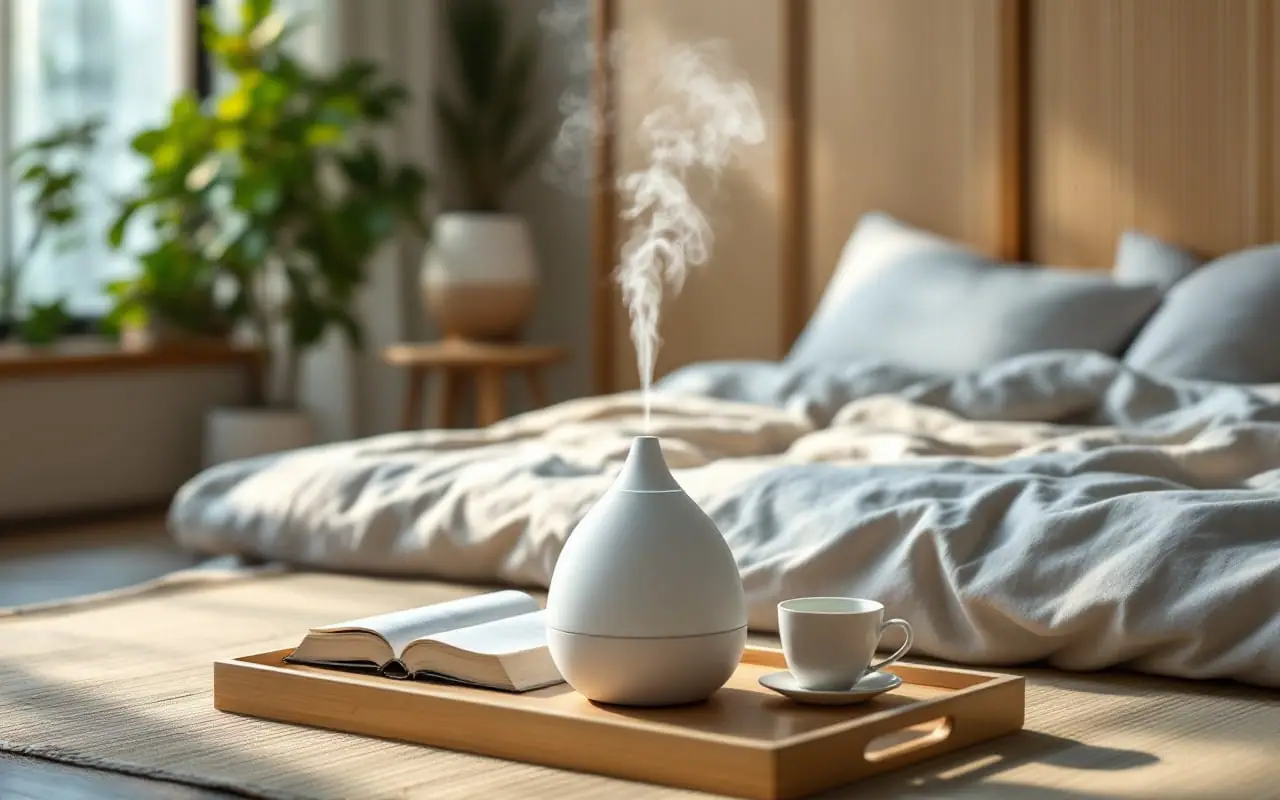
- In a diffuser: fill the tank to the line, add a few drops, and run it for 30 to 60 minutes while you read or stretch, then switch it off. The diffuser drops calculator gives a starting number for your tank and room. For a bedroom, a compact ultrasonic diffuser that switches off when the water runs out is enough. Empty, rinse and dry the tank afterward so it doesn't grow mold.
- On skin: a hand or foot rub at 1 percent (2 drops of essential oil in 10 ml of a plain carrier oil) is plenty. Patch test first on your inner forearm and wait 24 hours.
Running a diffuser all night is not a good idea. Hours of exposure can irritate the nose and airways, and your nose stops noticing a smell that never changes, so any benefit fades while the exposure carries on.
If you buy one bottle, make it true lavender oil labeled Lavandula angustifolia, in a small size you will finish within a year. Old, oxidized lavender is more likely to cause skin reactions.
Who should skip it or be careful
- Babies and young children: don't diffuse oils in a baby's room, and put nothing on the skin of a baby under three months. For older children, use less and keep oils away from their faces.
- Asthma: strong scents can tighten the chest. If you have asthma, start with a tissue rather than a diffuser, and stop if you cough or wheeze.
- Pregnancy and breastfeeding: ask a midwife or doctor first.
- Cats and other pets: cats are especially sensitive to essential oils, and birds more so. Never diffuse in a closed room an animal can't leave.
- Sleeping medicines: if you take sleeping tablets or anything else that makes you drowsy, don't stop or change them because a scent seems to help. Talk to whoever prescribed them first.
- Migraine: some people with migraine find that strong smells trigger attacks.
- Everyone: never swallow essential oils, and keep bottles out of children's reach.
When sleep trouble needs a doctor, not a diffuser
Some sleep problems need a proper look, and a pleasant scent can delay that if it becomes the whole plan.
Insomnia that has settled in
Trouble falling asleep, staying asleep or waking too early on at least three nights a week for three months, with tired, irritable days, is what doctors call chronic insomnia. It is common and treatable. The American College of Physicians recommends cognitive behavioral therapy for insomnia (CBT-I) as the first treatment to try: a structured program, usually over several weeks, that retrains sleep habits and the worry that builds up around them. Its benefits tend to last longer than those of sleeping pills. In Japan, CBT-I is offered at some suimin gairai (sleep outpatient clinics) and psychiatry departments, though availability varies by area. A family doctor is the place to start.
Snoring and pauses in breathing
Loud snoring most nights, a partner noticing that you stop breathing, waking up gasping or choking, morning headaches, a dry mouth, or nodding off during the day are signs of obstructive sleep apnea. Japan took notice in 2003, when a bullet train driver dozed off at the controls and was later found to have the condition. Here, testing often starts with a monitor worn overnight at home, and treatment, often a CPAP machine that keeps the airway open with gentle air pressure, can be covered by health insurance when the results meet the criteria. If you ever feel drowsy at the wheel, stop driving until you have been seen.
Children who snore loudly most nights, pause in their breathing, sleep with their mouth open, or are restless and irritable by day should see a pediatrician too. Enlarged tonsils and adenoids are a common cause.
Other reasons to book an appointment
- An urge to move your legs in the evening that eases when you move them (restless legs).
- Getting up several times a night to urinate.
- Heartburn or coughing when you lie down; the piece on acid reflux at night covers habits that help and the warning signs.
- Pain that wakes you.
- Low mood or anxiety lasting more than two weeks. If you have thoughts of harming yourself, get help the same day from a doctor or emergency services (119 in Japan, 911 in the US).
Tonight's version
Pick a fixed wake time for tomorrow. Stop caffeine after lunch. Bathe an hour or two before bed. Then, if you like the smell, put a drop of lavender on a tissue while you read, and switch off the light when your eyes get heavy. If several weeks of steady habits haven't helped, that is the signal to see a doctor rather than to buy a stronger oil.

The writer
Shun is a health journalist based in Fukuoka. He reads the guidance published by health ministries and medical bodies and explains how check-ups, seasons and everyday life in Japan touch our health.