Prebiotics vs probiotics: the difference, and where to find them
Prebiotics vs probiotics comes down to one line: probiotics are live microorganisms that can do you some good, and prebiotics are food for the microbes already living in your gut. One is a new tenant, the other is the groceries. They work in different ways, they turn up in different foods, and the evidence behind each is thinner and more specific than the supplement aisle suggests.
I live in Fukuoka, where the subject is hard to avoid. Small bottles of cultured milk drinks arrive on doorsteps, and TV ads talk about chonai kankyo (the "gut environment") as if everyone has one to tend like a vegetable plot. Here is how the two terms are defined, where they show up on your plate, and what the research supports.
Prebiotics vs probiotics at a glance
| Probiotics | Prebiotics | |
|---|---|---|
| What they are | Live microorganisms, usually bacteria or yeasts, that give a health benefit in adequate amounts | Substances, mostly certain fibers, that gut microbes use selectively, with a benefit to you |
| Alive? | Yes, at least when the product is made | No |
| Where you find them | Some yogurts, cultured milk drinks and supplements; many fermented foods carry live microbes but are not tested probiotics | Onions, leeks, garlic, burdock root, asparagus, slightly green bananas, wheat, barley, beans |
| What the evidence covers | Specific strains for specific problems, such as some diarrhea linked to antibiotics | Shifts in gut bacteria and, in some trials, stool habits; wider health effects are less clear |
| Usual side effects | Mild gas or bloating in the first days | Gas and bloating, especially in larger amounts |
Where the two definitions come from
In 2001 an expert group convened by the UN's Food and Agriculture Organization and the World Health Organization described probiotics as live microorganisms that, when given in adequate amounts, provide a health benefit to the person taking them. An international scientific association for the field confirmed that wording in 2014. So: alive, enough of it, and evidence of a benefit.
Prebiotics were first described in the mid-1990s as food ingredients that pass through the small intestine undigested and feed particular helpful bacteria in the colon. The same scientific association updated the definition in 2017: a substance that is selectively used by the microorganisms living in you and that gives a health benefit. The best-studied ones are inulin, fructooligosaccharides (often shortened to FOS) and galactooligosaccharides (GOS). Breast milk is full of related sugars that feed a baby's bifidobacteria, which is why some infant formulas add GOS and FOS.
Prebiotics are a small, well-defined slice of dietary fiber, and not all fiber counts. When bacteria in the colon ferment fiber, they produce short-chain fatty acids such as butyrate, which the cells lining the colon use for fuel. That much is well established. How far it explains wider health effects is still being worked out. Two newer label terms, synbiotics (a probiotic and a prebiotic in one product) and postbiotics (microbes that are no longer alive, or parts of them), are at an even earlier stage.
Foods with probiotics, and why most are something else
Search for foods with probiotics and you get long lists: yogurt, kefir, kimchi, sauerkraut, miso, natto, kombucha. Strictly, most of those are fermented foods, a different category: food made with the help of microbes. Some still carry plenty of live ones when you eat them, some carry none after pasteurizing, baking or cooking, and even live ones have rarely been tested for a particular effect.
My colleague Naoko Hirata covered the Japanese side in miso, natto and nukazuke, including raw versus pasteurized miso and why people on warfarin skip natto. In short:
- Yogurt and kefir usually contain live cultures, and some products add specific, studied strains. In the US, look for "live and active cultures" on the pack; yogurt that is heat-treated after culturing may have none.
- Cultured milk drinks, the small bottles common in Japan, are usually built around one named strain, and some have been studied for bowel habits.
- Sauerkraut, kimchi and pickles carry live microbes only when they are the refrigerated, unpasteurized kind. Pickles made with vinegar are not fermented at all.
- Miso, natto and nukazuke (vegetables pickled in fermented rice bran) carry live microbes when raw, fresh or homemade, far fewer in pasteurized miso or a soup that has boiled.
- Kombucha varies widely from bottle to bottle.
- Sourdough bread and tempeh are fermented, but baking and cooking kill the microbes.
None of this makes fermented foods less worth eating. It just means "fermented" or "contains live cultures" on a label is not a promise of any particular health effect.
Foods with prebiotics, starting in the kitchen
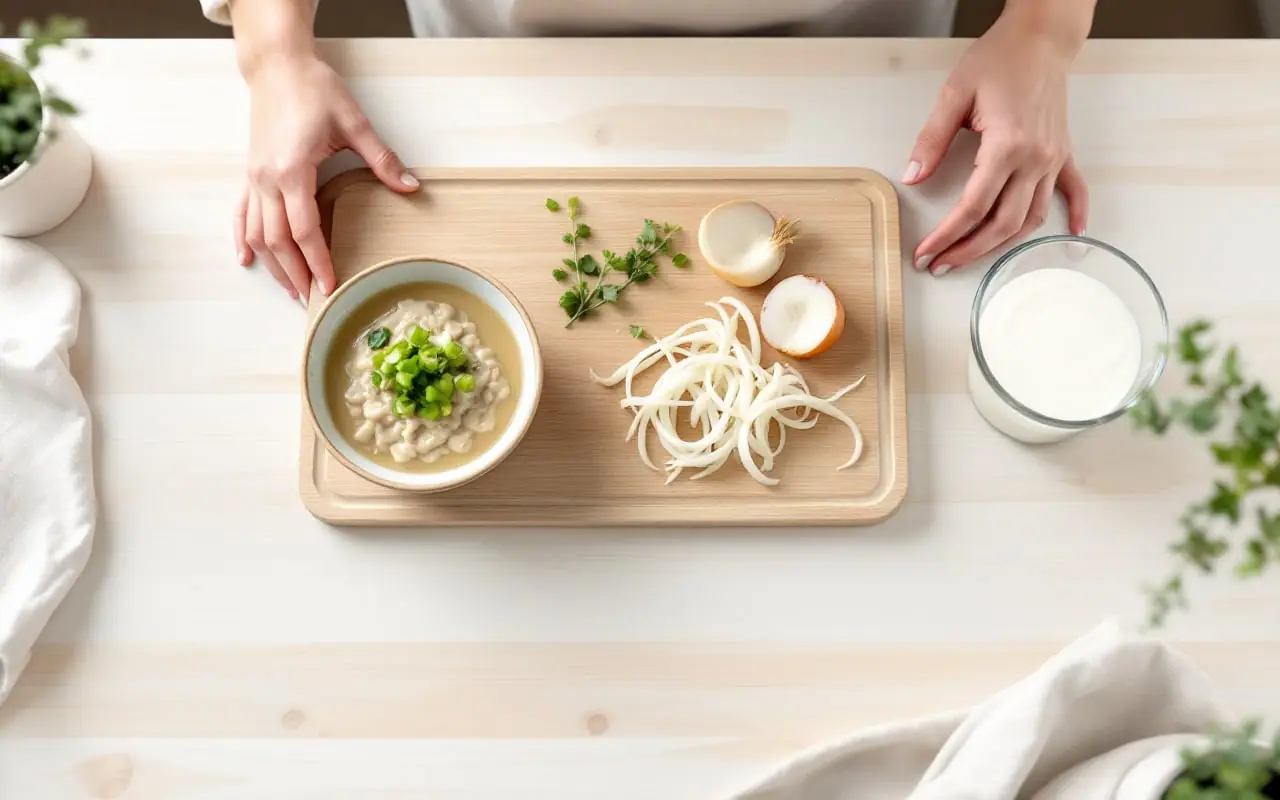
Prebiotic fibers are easier to find, because they sit in ordinary plants. The richest everyday sources of inulin and FOS are the onion family (onions, leeks, garlic, and negi, the long green onion that goes on almost everything in Japan), chicory root, Jerusalem artichokes and asparagus. Wheat and barley carry some. Beans and lentils carry GOS. Slightly underripe bananas bring resistant starch, another kind of carbohydrate that slips past digestion and is fermented in the colon.
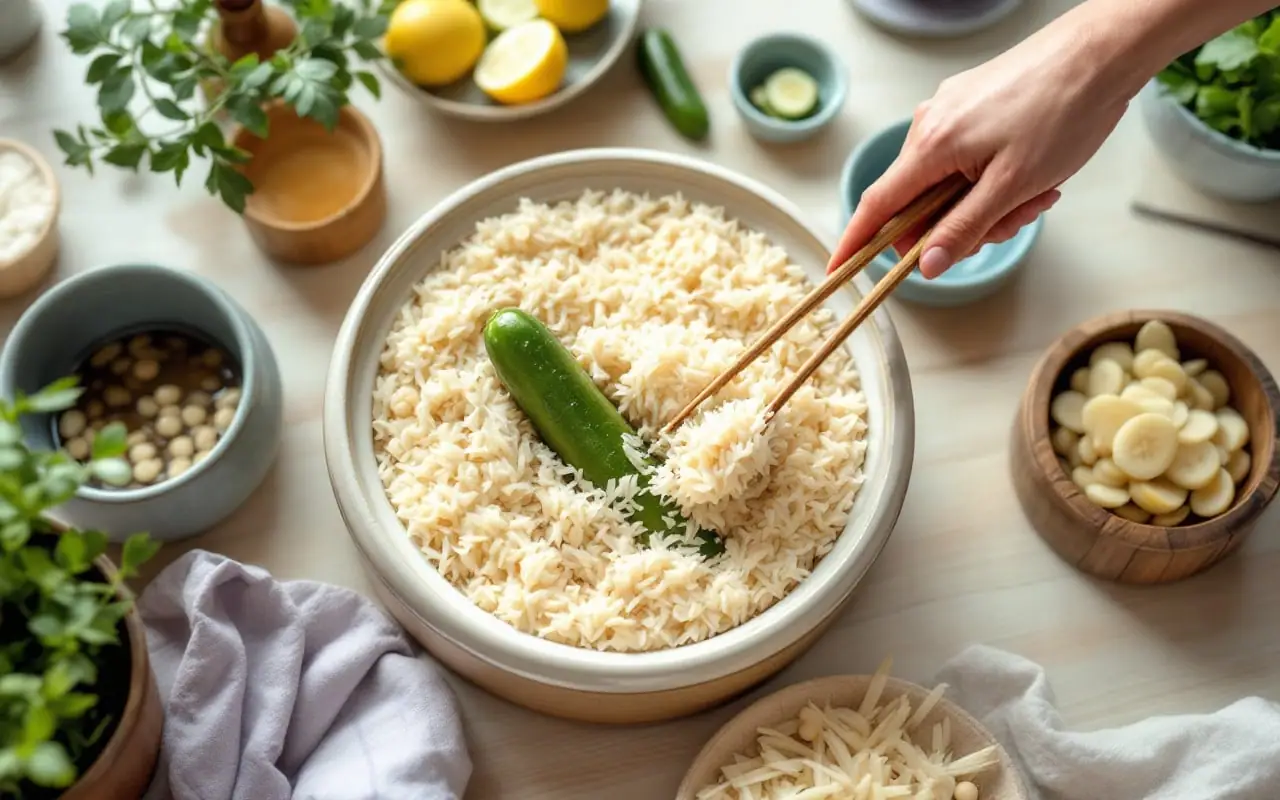
Burdock root, gobo, deserves a special mention because it is one of the more inulin-rich vegetables in a Japanese kitchen. Kinpira gobo (burdock and carrot slivers stir-fried with soy sauce and a little sugar) and tonjiru (a pork and vegetable miso soup) are two of the easiest ways to eat it. Rice cooked with barley, mugi gohan, adds fiber to a plain bowl. Rice that has been cooked and then cooled, as in an onigiri (rice ball) eaten at lunch, contains a little more resistant starch than the same rice eaten hot, though the amount is modest.
You rarely need to buy a prebiotic. Vegetables, beans, whole grains and fruit supply a range of fibers, and observational research suggests that people who eat a wider variety of plant foods tend to have a more varied community of gut microbes. Most adults fall short on fiber anyway. The US Dietary Guidelines suggest about 14 grams of fiber for every 1,000 calories, which works out to roughly 22 to 34 grams a day depending on age and sex, and most Americans eat far less. Japan's health ministry sets its own daily targets, and its national nutrition survey shows average intakes sitting below them as well.
What the research supports, and what it doesn't
Probiotics are where the most money goes and where the evidence is most uneven. Results belong to particular strains, not to probiotics as a group, and a good label names the strain in three parts: genus, species and a code of letters and numbers. Labels also shifted after 2020, when scientists split the large Lactobacillus genus into more than 20 smaller groups, so an older and a newer pack can name the same microbe differently.
The uses with the most support include lowering the risk of diarrhea linked to antibiotics in some people, and a few specific hospital uses under medical supervision. For irritable bowel syndrome, constipation and general "gut health", the results are mixed, and many trials are small, short or paid for by the makers. In 2020 the American Gastroenterological Association reviewed the evidence and recommended probiotics in only a few narrow situations; for several common conditions, including irritable bowel syndrome, it advised using them only within research studies.
Prebiotic research is younger. Inulin and FOS reliably increase bifidobacteria in the gut and, in some trials, make stools a little more frequent or softer in people prone to constipation. But a shift in the bacteria counted in a stool sample is not the same as fewer symptoms or better health, and many studies only measure the first. The US National Center for Complementary and Integrative Health keeps a plain-language summary of where probiotic research stands on its website.
Do you need a supplement?
For most healthy people, probably not, and I am not going to recommend one here. Food covers prebiotics well. For probiotics, ask the question the other way round: is there a specific reason, backed by evidence, for you? That is a conversation for a doctor or pharmacist who knows your history, not a decision to make from an advertisement.
It helps to know how these products are regulated. In the US, most probiotics are sold as dietary supplements, which do not need FDA approval before they go on sale, and the count on the label, in colony-forming units (CFU), may describe the product when it was made rather than at its use-by date. In Japan, health claims on food run through two main systems: tokuho (Foods for Specified Health Uses), where the government reviews the evidence for each product, and the newer Foods with Function Claims, where the company files its own evidence without government approval. Gut claims are among the most common in both.
Who should be careful
Probiotics are generally safe for healthy people, and the usual side effect is some extra gas for the first few days. The picture changes for people who are seriously ill or have a weakened immune system, for example during chemotherapy or after a transplant, and for premature babies. In those groups, rare but serious infections caused by the probiotic organism itself have been reported, and the FDA has warned about probiotic products given to premature infants in hospital. Anyone in these groups should use them only on a doctor's advice.
Prebiotics have their own downside. The same fibers that feed your gut bacteria produce gas as they are fermented, and inulin, FOS and GOS belong to the FODMAPs, the group of fermentable carbohydrates that trouble many people with irritable bowel syndrome. If onions, garlic or beans already leave you uncomfortable, a prebiotic powder is unlikely to feel better, and any extra fiber is best added slowly. The piece on bloating after meals covers the usual culprits and a simple way to test them at home.
When gut symptoms need a doctor, not a product
It is easy to spend months on yogurts and capsules for a problem that needs a proper look. See a doctor promptly if you notice blood in your stool or vomit, black or tarry stools, weight loss you cannot explain, trouble swallowing, vomiting that keeps coming back, severe or worsening belly pain, or a fever with gut symptoms. Make an appointment too if your bowel habits change and stay changed for more than a few weeks, especially from middle age onward, or if a symptom has not improved after a month of sensible changes.
In Japan the annual check-up is a good moment to raise it, and many towns offer bowel cancer screening with a simple stool test; there is more on what the check-up covers in health check-ups in Japan. Readers elsewhere will find clear pages on common digestive problems at the US National Institute of Diabetes and Digestive and Kidney Diseases site.
A food-first month
Keep it simple and give it a few weeks:
- Add one prebiotic-rich vegetable a day: onion or leek in a soup, a side of kinpira gobo, asparagus when it is in season.
- Swap some white rice or bread for whole grains, or cook rice with a spoonful of barley.
- Eat beans or tofu several times a week, starting with small portions if beans make you gassy.
- Include a fermented food you enjoy, such as plain yogurt, raw miso stirred into soup after the heat is off, or natto (unless you take warfarin).
- Raise fiber gradually over two to three weeks and drink enough water as you do.
- If a symptom that bothers you has not changed, take it to a doctor instead of the supplement shelf.
The one thing to remember: probiotics are microbes, prebiotics are their food, and for most people the simplest, best-supported way to get both is a varied plate with plenty of plants on it.
A note: links to Amazon here are affiliate links. As an Amazon Associate I earn from qualifying purchases.

The writer
Shun is a health journalist based in Fukuoka. He reads the guidance published by health ministries and medical bodies and explains how check-ups, seasons and everyday life in Japan touch our health.