Constipation: everyday causes, fiber from the Japanese kitchen and when to worry
Late November is when the kotatsu comes out in my house: the low table with a heater underneath and a quilt over the top. It begins a slow, warm, sitting-down season. It is also when friends start mentioning, a little quietly, that things have slowed down in another department too.
Benpi (constipation) is a word people in Japan use more openly than in many places. Pharmacy shelves carry a long row of remedies, and several of my friends could describe their bowel habits as readily as the weather. That frankness is useful. Constipation is common, usually harmless and usually eased with ordinary changes. It also has a short list of warning signs that should never be put down to too little fiber, and I will come to those.
What actually counts
There is no rule that says you must go once a day. Health services such as the NHS describe a normal range from three times a day to three times a week. What matters is change from your own normal, and how it feels.
Doctors generally call it constipation when you go fewer than three times a week, or when stools are hard, dry and lumpy, difficult or painful to pass, or leave you feeling you have not finished. Many use the Bristol stool scale, a seven-type chart that runs from hard separate lumps (type 1) to entirely liquid (type 7). Types 3 and 4, a sausage shape that is smooth or slightly cracked, are the comfortable middle. If you are usually at type 1 or 2, stool is spending too long in the colon, which keeps drawing water out of it the longer it stays.
A few slow days after a trip or an illness are very common. When it goes on for months, doctors call it chronic constipation, and that is worth raising with one even if nothing else seems wrong.
Seven everyday causes
Too little fiber. Fiber is the part of plant food we cannot digest. Insoluble fiber, from grain husks, vegetable skins and stalks, adds bulk. Soluble fiber, from seaweed, barley, beans and fruit, holds water and turns soft and gel-like. Both help. Japan's health ministry sets daily fiber targets for adults, and national nutrition surveys suggest most adults here fall short, partly because we eat less rice, barley and beans than earlier generations did.
Too little fluid. In summer, thirst keeps people drinking. As the weather cools, many of us simply forget. Fiber without enough fluid can make hard stools harder.
Sitting still. Movement helps the bowel move. Long hours at a desk, a week in bed with a cold or a winter evening under the kotatsu all slow things down, and older people who become less mobile are especially prone.
Ignoring the urge. The bowel tends to wake up after a meal, particularly breakfast, a pattern called the gastrocolic reflex. Rushing out the door or waiting for a better moment means the urge fades and the stool keeps drying out. Plenty of Japanese adults remember holding on all day at primary school rather than be teased for using the toilet there, and that habit can last for decades.
Eating too little. Skipping breakfast and strict dieting shrink the volume passing through, and there is less to set the bowel going at all. This is one reason constipation is so common among young women who diet.
Travel and changes in routine. New time zones, unfamiliar toilets and holiday food all count, and the slowdown usually sorts itself out once you are home.
Medicines and health conditions. Iron tablets, antacids containing aluminum or calcium, codeine and other strong painkillers, some antidepressants, some blood pressure medicines, older antihistamines and medicines for an overactive bladder can all cause constipation. So can pregnancy, an underactive thyroid, diabetes, Parkinson's disease and irritable bowel syndrome. If it started around the time you began a new medicine, ask your pharmacist before stopping anything.
One more, very Japanese: the barium stomach X-ray that is part of many check-ups. The chalky drink can harden in the bowel, which is why you are handed a laxative afterward and told to drink plenty. If you have not passed pale stools within a day or two, or you develop belly pain, contact the place that did the test.
Fiber from a Japanese kitchen
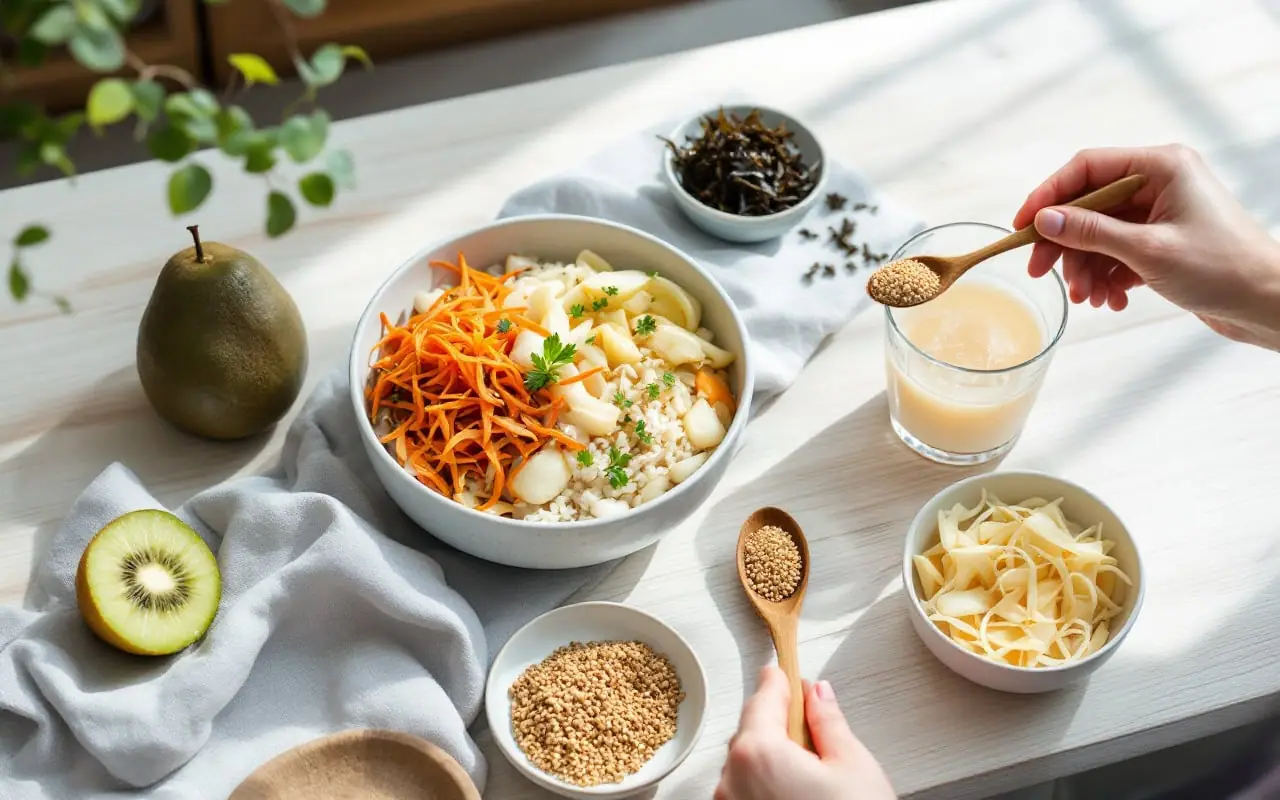
Japanese home cooking is full of fiber, as long as you choose the old-fashioned dishes. These are what I lean on through late autumn and winter.
| Food | What it brings | An easy way in |
|---|---|---|
| Pressed barley (oshimugi) or brown rice | Insoluble fiber, plus soluble fiber in barley | A spoonful or two of barley cooked in with white rice |
| Gobo (burdock root) | Plenty of both kinds | Kinpira gobo, burdock and carrot stir-fried with soy and sesame |
| Kiriboshi daikon (sun-dried shredded daikon) | Concentrated fiber, cheap, keeps for months | Simmered with carrot and fried tofu |
| Hijiki, wakame and other seaweeds | Soluble fiber | Wakame in miso soup, hijiki simmered with soybeans |
| Konnyaku (konjac) | A soluble fiber called glucomannan | Sliced thin in oden or simmered vegetables |
| Natto and other soybeans | Fiber with protein | Natto over rice, soybeans in the hijiki |
| Okara (soy pulp left from tofu making) | One of the richest everyday sources | Unohana, okara simmered with vegetables |
| Sweet potato and kabocha | Fiber with natural sweetness | Steamed or roasted, skin on |
| Mushrooms | Fiber with almost no fat | Shiitake, shimeji or enoki in a hot pot |
| Kiwifruit and prunes | Fruit fiber; small trials suggest both help some people | Kiwi at breakfast, a few prunes as a snack |
Three cautions go with the table. First, add fiber slowly, over two or three weeks. A sudden leap from white rice to bowls of beans and burdock brings gas and bloating before the gut adjusts, as I described in bloating after meals. Second, drink more as you add it. Third, the little cup jellies made from konnyaku are a known choking hazard for small children and older people and carry warnings in Japan for that reason. Konnyaku cut small in a cooked dish is a different thing.
Fermented foods such as natto and nukazuke (rice bran pickles) are good to have on the table, but the evidence that they ease constipation is thin. A few specific probiotic strains have small trials behind them. I went through what fermented foods can and cannot do in miso, natto and nukazuke.
On the toilet
How you sit matters more than most people expect. The old Japanese squat toilet, still found in some stations and parks, puts the body in a position that straightens the bend at the end of the bowel. Western seats are kinder to knees but keep you more upright, and you can get some of the squat back without giving up the seat.
- Go when you feel the urge. Even when you do not, give yourself ten unhurried minutes after breakfast, so the gastrocolic reflex has a chance.
- Rest your feet on a low stool so your knees sit higher than your hips. Small studies suggest this makes emptying easier for some people.
- Lean forward with your forearms on your thighs and keep your back fairly straight.
- Let your belly relax and push forward. Breathe out slowly instead of holding your breath and straining.
- Leave the phone outside. If nothing happens after a few minutes, get up and try later. Long straining sessions are linked with hemorrhoids and small tears called anal fissures.
- Go easy on the bidet spray. Some people use the warm-water jet built into many Japanese toilets to coax a bowel movement, and doctors in Japan have cautioned that frequent strong spraying can irritate the skin around the anus. A gentle setting for cleaning is fine.
Laxatives, in plain terms
If food, fluids, movement and better toilet habits have not helped after a week or two, a pharmacy laxative can be reasonable for a short time. A pharmacist can match one to your situation and your other medicines.
Bulk-forming laxatives, such as psyllium husk, work like extra fiber. They take a couple of days and need plenty of water, or they can make things worse.
Osmotic laxatives draw water into the bowel to soften the stool. Magnesium oxide is one of the most widely used in Japan, often for years at a time. It is generally gentle, but magnesium can build up in older people and in people with kidney problems, and Japan's drug safety authorities have warned doctors to watch for this. It can also reduce the absorption of some other medicines, including certain antibiotics. Macrogol and lactulose are other osmotic options.
Stimulant laxatives, such as senna and bisacodyl, make the bowel muscles contract. They work within hours, cause cramps in some people, and are best kept for occasional use unless a doctor says otherwise. Many herbal slimming or "bowel" teas contain senna, so read the label. Some kampo formulas sold for constipation contain rhubarb root (daio), which acts in a similar way, and some also contain licorice, which can lower potassium. Ask a pharmacist before taking one alongside other medicines.
The old fear that stimulant laxatives permanently damage the bowel is not well supported by modern research. The real risks of taking any laxative every day without advice are dehydration, low potassium and, above all, covering up a problem that needed a doctor. Children, pregnant women, older people on several medicines and anyone with kidney or heart disease should ask a doctor or pharmacist first. Doctors in Japan also have several newer prescription medicines for long-term constipation, so if pharmacy products have stopped working, that is a reason to see one rather than to double the dose.
When it is not just constipation
Get urgent care, calling 119 in Japan or your local emergency number elsewhere, for severe belly pain; a swollen, hard belly with vomiting and no passing of wind or stool, which can mean a blockage; heavy bleeding from the bottom or feeling faint; or a fever with belly pain.
See a doctor soon if you notice:
- blood in or on your stool, or black tarry stools, even if you suspect hemorrhoids
- a change in your usual bowel habit that lasts more than about three weeks, especially if you are over 50
- weight loss you cannot explain
- unusual tiredness or breathlessness, which can be a sign of anemia
- constipation that alternates with diarrhea
- a family history of bowel cancer
- no improvement after two or three weeks of the changes above, or needing laxatives most days
- pain when passing stool that makes you hold on
If the yearly stool test for hidden blood at a city or workplace check-up comes back positive, book the follow-up colonoscopy. Many people put it off, assuming hemorrhoids, and a second stool test is not a substitute. Our guide to health check-ups in Japan explains how bowel screening works here, and the US National Institute of Diabetes and Digestive and Kidney Diseases has clear pages on constipation and its tests.
Children get constipated too, and it can turn into a painful cycle of holding on. If a child is in pain, soiling their underwear or passing blood, see a pediatrician, and do not give adult laxatives without advice.
Where I would start tomorrow
Breakfast, then ten quiet minutes. Cook a spoonful of barley in with the rice, put wakame in the miso soup, and drink a glass of water before the first cup of tea. Keep a low stool by the toilet. Give it two weeks. If any of the warning signs above apply to you, skip the experiment and see a doctor first.

The writer
Naoko is a food and nutrition writer from Fukuoka who studied nutrition before she took up writing. She covers gut health and everyday eating, and most of her ideas start at the kitchen counter.